 info@bamchocolate.com
  Login
Login 

 en
en 
 BAM Cake converter
  Login
Login Claudia
Avtorica vsebin


 Reading time:
11 minutes
Reading time:
11 minutes 
Discover why baking ingredients matter and how they impact flavor and texture. Unlock your baking potential with expert tips and insights!
TL;DR:
- Baking ingredients play a crucial role because baking is a chemical process that relies on specific components for structure and flavor. Choosing quality flour, leavening agents, butter, and flavor extracts significantly impacts the final product’s texture, taste, and appearance. Proper storage and understanding ingredient functions help bakers achieve consistent, high-quality results.
Most home bakers assume that any bag of flour or block of butter will do the job. That assumption is why baking ingredients matter far more than most people realise. Baking is a chemical process, not just a cooking method, and every ingredient plays a specific role in that process. Swap one component carelessly and you change the structure, flavour, and texture of the final result. This guide breaks down the science behind key ingredients, explains what goes wrong when quality is ignored, and gives you practical advice to bake better from your very next session.
| Point | Details |
|---|---|
| Flour protein content is decisive | Choosing the right flour protein level directly controls texture, crumb, and volume in every bake. |
| Leavening agents are not interchangeable | Baking soda and baking powder have distinct chemical roles; confusing them produces flat or bitter results. |
| Butter quality and storage affect flavour | Rancid or improperly stored butter degrades taste long before any visible signs appear. |
| Premium vanilla and cocoa butter pay off | A small cost increase for quality vanilla extract or cocoa butter delivers a noticeable flavour and texture return. |
| Prioritise upgrades by impact | Start with the ingredients that affect flavour most directly, then expand your quality sourcing from there. |
Flour looks simple. It is not. The single most predictive metric for how a flour will behave is its protein content, which controls gluten formation and therefore the texture of everything you bake.
When flour meets water and is mixed, two proteins called glutenin and gliadin combine to form gluten. Gluten is the elastic network that traps gas bubbles produced by leavening agents, giving baked goods their rise and structure. More protein means stronger gluten. That is exactly what you want in bread. It is the opposite of what you want in a delicate sponge cake.
| Flour type | Typical protein content | Best used for |
|---|---|---|
| Cake flour | 5.5–8.0% | Sponge cakes, chiffon, cupcakes |
| Plain (all-purpose) flour | 10–12% | Biscuits, pancakes, general baking |
| Bread flour | 12–14% | Bread, pizza dough, bagels |
| Strong wholemeal flour | 13–15% | Artisan loaves, dense rolls |
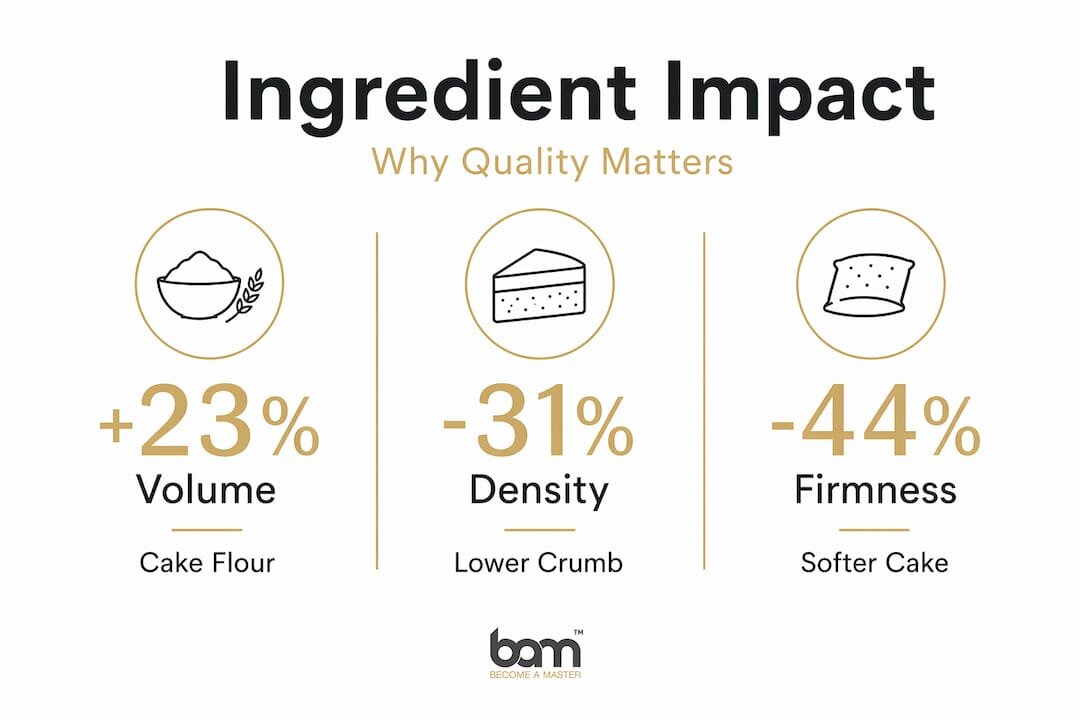
The numbers matter in practice. Cakes made with cake flour showed 23% greater volume, 31% lower crumb density, and 44% longer moisture retention compared to batches made with all-purpose flour. Using the wrong flour does not just change the texture slightly. It fundamentally changes the product.
Choosing flour by protein type and quality goes beyond reading the number on the label. The source of the wheat, the milling process, and whether the flour has been bleached all influence how the proteins behave in your dough or batter. Bleached cake flour, for instance, has weakened protein bonds that produce a more tender crumb.
Pro Tip: Check the nutritional label on your flour bag. The protein value listed per 100g is your guide. For cakes, aim below 9g. For bread, aim above 12g.
This is where many home bakers quietly go wrong. Baking soda requires an acid to activate and produce the carbon dioxide gas that makes batters rise. Baking powder contains its own acid and activates on contact with moisture and again with heat. They are not the same ingredient in different concentrations. They are chemically distinct tools.
Baking soda is 3 to 4 times more potent than baking powder. Use too much baking soda and the batter rises fast, then collapses before it sets. Use too much baking powder and you get a bitter, metallic aftertaste. Swap one for the other without adjusting the recipe and you will reliably produce something flat, soapy, or both.
Here is what to keep in mind when working with leavening agents:
Understanding the distinct chemical roles of these two agents is one of the fastest ways to eliminate unexplained baking failures. Bamchocolate has a detailed resource on using baking powder and soda that is worth reading before your next bake.
Pro Tip: If a recipe calls for both baking soda and baking powder, the soda is neutralising excess acid while the powder provides the main lift. Do not omit either one.
Butter is mostly fat, and fat is where flavour lives. The quality of butter you use, and how you store it, has a direct and measurable effect on how your baked goods taste.
| Butter type | Refrigerated shelf life | Room temperature shelf life |
|---|---|---|
| Unsalted butter | 1–2 months | 3–5 days |
| Salted butter | 3–5 months | 10–14 days |
| Clarified butter (ghee) | Up to 12 months | Up to 3 months |
Salted butter lasts significantly longer than unsalted because salt acts as a preservative. That is precisely why most professional bakers use unsalted butter. It has a shorter shelf life, but it gives you full control over the salt content of your recipe.
The more serious concern is oxidative rancidity. Butter spoilage begins via oxidative rancidity long before it smells or looks off. Exposure to UV light increases rancidity markers by 320% in just four hours. You can use butter that appears perfectly normal and still notice a stale, slightly off flavour in your finished bake.
Practical storage rules for home bakers are straightforward. Keep unsalted butter in the coldest part of your fridge, wrapped tightly to block light and air. Never leave it sitting on the counter in a clear dish near a window. If you buy in bulk, freeze it. Frozen butter retains quality for up to six months and thaws well overnight in the fridge.
Pro Tip: For pastry and laminated doughs like croissants, butter temperature is as important as butter quality. Use butter straight from the fridge for rubbing into flour, and allow it to reach exactly 16°C for lamination work.
There is a category of ingredients where the gap between standard and premium is immediately noticeable to anyone eating the result. Vanilla extract and cocoa butter sit firmly in that category.
Upgrading to high-quality vanilla extract costs only 10 to 15 pence more per recipe. The flavour difference is picked up even by people who do not bake and would not normally notice ingredient quality. Real vanilla extract contains over 200 flavour compounds. Imitation vanilla contains one: vanillin. The depth and warmth you get from genuine extract cannot be replicated by a synthetic version, no matter how much you use.
Cocoa butter is a more significant investment, but it is non-negotiable for quality chocolate work. Cocoa butter gives chocolate its characteristic solid snap and smooth melt, and it costs two to three times more than cocoa powder. Cheaper fats used as substitutes do not crystallise in the same way and produce a greasy, waxy mouthfeel instead.
The science behind this is specific. Cocoa butter crystallisation in Form V is what gives properly tempered chocolate its gloss, snap, and clean melt at body temperature. No other fat behaves this way. Substituting it is not a minor compromise. It changes the fundamental sensory experience of the product.
Here is where premium ingredients deliver the clearest return:
Knowing why baking ingredient quality matters is one thing. Building it into your regular kitchen practice is another. The good news is that you do not need to upgrade everything at once.
Start by identifying which ingredients have the most direct impact on flavour in your most-used recipes. Vanilla extract, butter, and chocolate are almost always at the top of that list. Flour type matters most when you bake a wide variety of goods. If you only make bread, invest in good bread flour. If you mostly bake cakes, cake flour and quality butter will give you the biggest return.
Follow this sequence when integrating better ingredients:
For practical guidance on baking cakes with quality ingredients, Bamchocolate has a resource that covers technique alongside ingredient selection.
I spent years following recipes precisely and still getting inconsistent results. The frustration was real. Then I started paying attention to the ingredients themselves rather than just the method, and the improvement was immediate.
The change that surprised me most was vanilla extract. I had always bought the cheapest bottle available. Switching to a genuine extract felt like a minor decision. The difference in flavour was not minor at all. It was the kind of change that made people ask what I had done differently.
Where I push back on the “always buy premium” advice is with supporting ingredients. Salt, plain sugar, and water do not need to be artisan products. The quality ceiling for those ingredients is low because their role in flavour is limited. Spend your budget where it changes the result: fat, flavour extracts, chocolate, and flour type.
The most useful thing I have learned is that premium vanilla extract is the single most cost-effective upgrade a home baker can make. It costs almost nothing extra per recipe and the return is immediate. Start there. Then work through your ingredient list methodically.
Baking is a system. Every component either supports or undermines the whole. Once you understand that, you stop treating ingredients as interchangeable and start treating them as the actual source of quality in your baking.
— Andraz
Understanding the baking ingredients impact on your results is the first step. The next is having access to the right products. Bamchocolate stocks a focused range of baking additives and accessories selected for home bakers who want consistent, quality results without sourcing from multiple suppliers.
If you want to put these principles into practice straight away, the BAM pastry recipe book gives you 101 recipes built around quality ingredients, with clear guidance on why each component is chosen. For those starting out or looking to experiment, the BAM Basic pastry package brings together a curated set of premium baking essentials in one order.
Good baking starts with good ingredients. Bamchocolate makes sourcing them straightforward.
Yes, significantly. Cake flour produces 23% greater volume and 31% lower crumb density compared to all-purpose flour, making flour choice one of the most impactful decisions in any bake.
Not directly. Baking soda is 3 to 4 times more potent than baking powder and requires an acid to activate, so substituting without adjusting quantities and recipe acidity will produce unreliable results.
Rancidity in butter begins well before visible or smell signs appear. If your baked goods have a faintly stale or off flavour despite a correct recipe, check how long your butter has been stored and whether it has been exposed to light or air.
Yes. Premium vanilla extract costs only 10 to 15 pence more per recipe and is consistently identified as the most impactful single ingredient upgrade available to home bakers.
Cocoa butter’s Form V crystal structure is unique. It gives chocolate its snap and clean melt at body temperature. No other fat replicates this behaviour, so substitutes always produce an inferior texture and mouthfeel.




 Confectionery tips



 Slovenščina
 Hrvatski
 Deutsch
 Italiano
 Česky
Česky
 Polski
 Magyar
 Français
 Slovák
 Nederlands
 Español