 info@bamchocolate.com
  Login
Login 

 en
en 
 BAM Cake converter
  Login
Login Claudia
Avtorica vsebin


 Reading time:
10 minutes
Reading time:
10 minutes 
Discover what is lactose-free baking and learn how to create delicious, digestive-friendly treats for everyone. Start baking confidently today!
TL;DR:
- Lactose-free baking uses dairy products treated with lactase enzyme, making them safe for lactose intolerant individuals but not for milk allergy sufferers. It allows for straightforward ingredient swaps, maintains authentic textures, and requires minor recipe adjustments like sugar reduction and moisture control. Proper understanding and techniques ensure delicious lactose-free desserts that preserve flavor and quality without unnecessary complexity.
Lactose-free baking is not the same as dairy-free baking, and that distinction matters more than most bakers realise. What is lactose-free baking, exactly? It is the practice of using dairy products that have had their lactose removed or broken down, so that people with lactose intolerance can enjoy baked goods without digestive discomfort. You still use real milk, real butter, and real cream cheese. You just use versions that have been treated to remove the problematic sugar. This guide covers the science, the ingredient swaps, the practical techniques, and the recipe ideas you need to bake confidently for lactose-intolerant friends, family, or yourself.
| Point | Details |
|---|---|
| Lactose-free is not dairy-free | Lactose-free products still contain milk proteins and are unsuitable for milk allergy sufferers. |
| 1:1 substitution works | Lactose-free milk replaces regular milk at the same ratio with minimal effect on texture. |
| Sweetness increases | Enzymatic breakdown of lactose produces sweeter dairy; reduce sugar slightly to compensate. |
| Moisture management matters | Lactose-free cream cheese holds more free water, requiring stabilisers and technique adjustments. |
| Technique is key | Water baths and low, extended baking temperatures produce the best lactose-free cheesecakes. |
To understand lactose-free baking properly, you need to understand what lactose actually does. Lactose is a disaccharide sugar found naturally in milk. People with lactose intolerance lack sufficient lactase enzyme to break it down in the gut, which leads to bloating, cramping, and other symptoms. Lactose-free milk is regular cow’s milk treated with lactase enzyme that pre-digests the lactose into two simpler sugars: glucose and galactose.
The result is a product that is nutritionally equivalent to standard milk but far easier to digest. Lactose-free milk provides the same calcium, protein, and vitamins as regular milk, with none of the digestive discomfort for intolerant individuals. That is an important point: you are not losing nutritional value when you bake lactose-free.
The enzymatic breakdown does change one thing noticeably: flavour. Glucose and galactose taste sweeter than lactose, so lactose-free dairy has a subtly sweeter profile. Baked goods made with lactose-free milk have a sweeter flavour, which many bakers consider a bonus in cakes and muffins but something to watch in savoury applications.
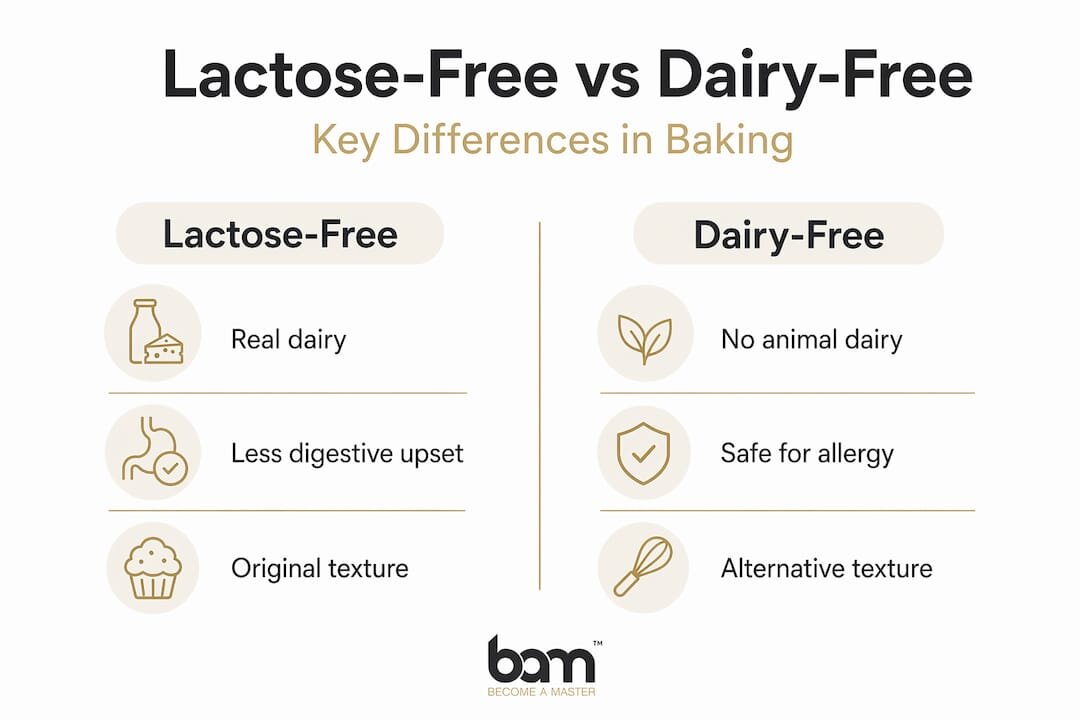
Here is where the critical distinction lives. Lactose intolerance is caused by lactose malabsorption, not by an immune reaction to milk proteins. A milk allergy is an entirely different condition that requires complete avoidance of all dairy proteins. Lactose-free products still contain those proteins. If you are baking for someone with a confirmed milk allergy, lactose-free dairy is not safe. Dairy-free or vegan alternatives are required instead. Understanding this boundary protects the people you bake for.
Pro Tip: If you are unsure whether someone has lactose intolerance or a milk allergy, always ask before you bake. The two conditions require completely different ingredient approaches.
The good news for bakers is that the swap from regular dairy to lactose-free dairy is almost always straightforward. Lactose-free baking primarily involves replacing lactose-containing dairy with lactose-free versions; everything else in the recipe stays the same. Eggs, flour, raising agents, and fats that are not dairy-based remain untouched.
Here are the key lactose-free dairy substitutes and how they perform:
The table below clarifies how lactose-free dairy compares to its alternatives:
| Ingredient type | Contains dairy proteins | Suitable for lactose intolerance | Suitable for milk allergy | Suitable for vegan diet |
|---|---|---|---|---|
| Regular dairy | Yes | No | No | No |
| Lactose-free dairy | Yes | Yes | No | No |
| Dairy-free (plant-based) | No | Yes | Yes | Depends on product |
| Vegan alternatives | No | Yes | Yes | Yes |
Lactose-free dairy maintains real dairy proteins, which is precisely why it produces authentic textures in baking. A cheesecake made with lactose-free cream cheese sets, slices, and tastes like a proper cheesecake. The same result is much harder to achieve with plant-based cream cheese substitutes, which behave differently under heat and often lack the fat structure needed for a clean set.
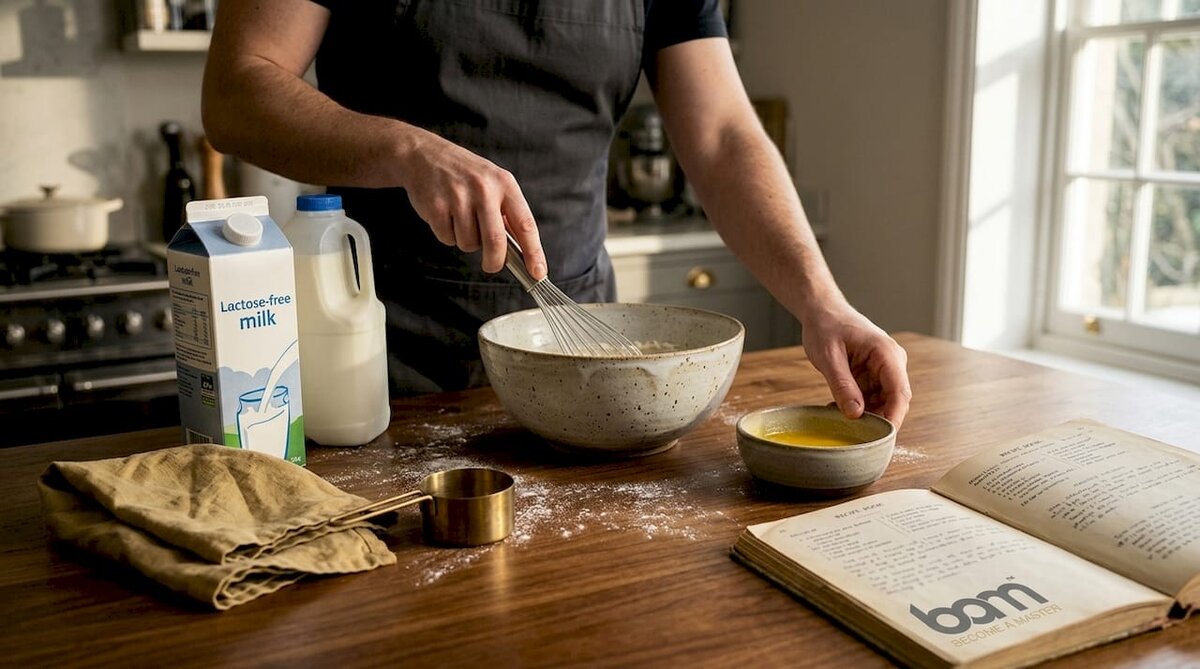
Pro Tip: When baking for a group with mixed dietary needs, check whether you need lactose-free dairy or fully dairy-free alternatives. Getting this wrong can cause real harm to someone with a milk allergy. Read labels carefully, as some products marketed as “lactose-free” are processed on shared equipment with regular dairy.
It is also worth noting that bakers often confuse lactose-free with dairy-free, using lactose-free dairy when a fully non-dairy alternative is actually required. If you want to understand the distinction further, the Bamchocolate article on vegan versus dairy chocolate offers a useful parallel for chocolate-based baking decisions.
Switching to lactose-free dairy is not simply a matter of swapping one bottle for another and hoping for the best. A few targeted adjustments make the difference between a good result and a great one.
Reduce sugar slightly. Because sugar levels may need adjusting due to the natural sweetness from enzymatic lactose breakdown, reduce the sugar in your recipe by roughly 10 to 15 per cent when using lactose-free milk or cream. This is especially noticeable in cheesecakes and custards where dairy is the dominant flavour. A healthy sugar substitute can also help you manage sweetness precisely.
Add a stabiliser when using lactose-free cream cheese. The higher free water content in lactose-free cream cheese means your cheesecake batter is more prone to weeping or cracking. Add one to two tablespoons of cornflour per 500g of cream cheese to absorb excess moisture and hold the structure.
Bring cream cheese to room temperature. Lactose-free cream cheese requires room temperature warming before mixing to prevent lumps and produce a smooth, even batter. Cold cream cheese, whether lactose-free or standard, will never incorporate cleanly.
Use a water bath for cheesecakes. Successful lactose-free cheesecake baking benefits from extended baking at low temperatures combined with a water bath. The humid environment prevents the surface from drying and cracking, which is more likely with the extra free water in lactose-free dairy.
Test for doneness with the wobble method. Rather than relying on a skewer, gently shake the tin. A properly baked cheesecake should wobble like set jelly in the centre, not slosh like liquid. Remove it from the oven at this point and allow it to cool slowly in the switched-off oven with the door ajar.
Do not over-mix. Excess air incorporated during mixing creates cracks as the cheesecake bakes and contracts. Mix on low speed and stop as soon as the batter is smooth.
For general cake baking techniques that apply equally well to lactose-free recipes, Bamchocolate has a dedicated resource worth bookmarking.
Pro Tip: Adjusting sweetness and moisture balance are the two biggest challenges in lactose-free baking. Address both upfront in your recipe and you will rarely need to troubleshoot after the fact.
Once you understand the substitutions and techniques, the range of lactose-free dessert recipes you can produce is genuinely broad. The goal is always to replicate the flavour and texture of the original, and with lactose-free dairy, that is very achievable.
The common thread across all of these is that lactose-free dairy maintains baking functionality while requiring only subtle recipe modifications. You are not reinventing your baking. You are refining it.
The most common mistake I see is bakers treating “lactose-free” and “dairy-free” as interchangeable. They are not, and the consequences of that confusion range from a disappointing texture to a genuine health risk for someone with a milk allergy. I have watched bakers swap in oat milk or almond cream cheese when a lactose-intolerant guest simply needed lactose-free dairy. The result is a completely different product, often with a noticeably altered texture and flavour.
In my experience, the sweetness shift is the adjustment most bakers underestimate. The first time you bake a cheesecake with lactose-free cream cheese and forget to reduce the sugar, the result is noticeably cloying. Once you account for it, the flavour is actually cleaner and more rounded than the standard version.
What I find most useful is thinking of lactose-free baking as precision baking. Lactose-free baking is an effective symptom management strategy, not a compromise. The ingredients are real dairy. The textures are authentic. The only variables are sweetness and moisture, and both are easy to manage once you know they are there.
— Andraz
Bamchocolate stocks a range of baking accessories designed for precise ingredient handling, including the stabilisers, moulds, and tools that make lactose-free baking more consistent. For bakers working on creamy fillings and confectionery, the BAM Confectionery set Creamy fillings offers specialist ingredients compatible with lactose-free techniques. If you want structured recipe guidance, the 101 BAM pastry recipe book covers a wide range of pastry and dessert applications. Whether you are baking a single cheesecake or building a full lactose-free dessert menu, Bamchocolate has the products and resources to support every stage of the process.
Lactose-free baking means using dairy products that have had their lactose broken down by lactase enzyme, making them safe for people with lactose intolerance. It is distinct from dairy-free baking, which removes all dairy entirely.
Yes. Lactose-free milk replaces regular milk at the same volume in virtually all baking recipes, with only a slight increase in sweetness to account for.
No. Lactose-free dairy still contains milk proteins and is not suitable for anyone with a milk allergy. Those individuals require fully dairy-free or vegan alternatives.
Lactose-free cream cheese contains more free water than standard cream cheese, which can cause baked goods to weep or crack. Using a cornflour stabiliser and baking at a low temperature in a water bath addresses this.
The flavour is very close to standard baking. The main difference is a slightly sweeter profile due to the breakdown of lactose into glucose and galactose. Reducing sugar by around 10 to 15 per cent in dairy-heavy recipes compensates for this.



 Confectionery tips


 Slovenščina
 Hrvatski
 Deutsch
 Italiano
 Česky
Česky
 Polski
 Magyar
 Français
 Slovák
 Nederlands
 Español