 info@bamchocolate.com
  Login
Login 

 en
en 
 BAM Cake converter
  Login
Login Claudia
Avtorica vsebin


 Reading time:
10 minutes
Reading time:
10 minutes 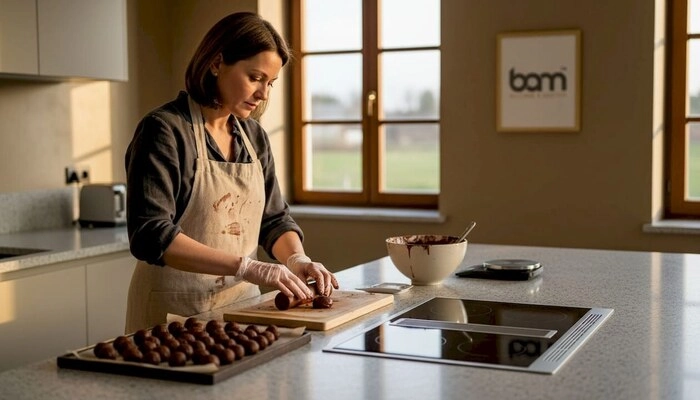
Discover what a chocolate truffle is, its rich history, and how to make this luxurious treat at home. Indulge in sweet simplicity!
TL;DR:
- Chocolate truffles are simple yet luxurious confections made from ganache coated in cocoa powder, nuts, or chocolate shells. They originate from a 1895 French creation that resembles the truffle fungus, with regional variations evolving over time. Proper ingredients, temperature control, and patience are key to making delicious homemade truffles that last up to two weeks refrigerated.
Chocolate truffles sit at the intersection of simplicity and luxury. A chocolate truffle is a small, round confection built around a ganache centre, typically coated in cocoa powder, chopped nuts, or a chocolate shell. Many people assume they are the exclusive territory of professional chocolatiers, but that reputation is largely undeserved. Once you understand what a chocolate truffle is made of and how the process works, you will find it is one of the most achievable homemade treats in confectionery. This article covers the history, chocolate truffle ingredients, preparation techniques, and the best variations for gifting or baking.
| Point | Details |
|---|---|
| Core definition | A chocolate truffle is a ganache ball coated in cocoa powder, nuts, or chocolate. |
| Two key ingredients | High-quality chocolate and heavy cream form the ganache foundation of every truffle. |
| Chilling, not freezing | Refrigerating ganache overnight gives the ideal texture; freezing ruins it. |
| Endless customisation | Liqueurs, spices, and varied coatings make truffles highly adaptable for gifting or baking. |
| Accessible to beginners | With the right technique and patience, truffles are among the most approachable luxury confections. |
The chocolate truffle as we know it today has a precise and rather charming origin. Louis Dufour created the first chocolate truffles in 1895 in Chambéry, France, when he ran short of ideas for a Christmas confection and improvised by rolling ganache balls in cocoa powder. The result was a rough, irregular sphere that bore a striking resemblance to the prized truffle fungus found underground in French and Italian forests. That visual similarity is precisely why are they called truffles.
The name stuck, and the concept spread quickly across Europe. By the early twentieth century, French and Belgian chocolatiers were refining the recipe, experimenting with cream ratios and adding coatings beyond plain cocoa powder. The history of chocolate shows that ganache itself only became a standard confectionery technique in the mid-nineteenth century, meaning truffles arrived at exactly the right moment to benefit from that knowledge.
Several distinct regional styles emerged over the following decades:
Each style reflects local chocolate culture and available ingredients, but all trace their lineage back to that improvised French ganache ball from 1895.
The chocolate truffle definition is deceptively simple: ganache in a coating. But the quality of each ingredient determines everything about the final result.
Traditional truffles require rich chocolate and heavy cream, with optional additions like butter or liqueurs to adjust texture and flavour. Understanding what each component does helps you make better decisions at every stage.
Experts recommend 60 to 70% cocoa content for optimal truffle flavour. Below 60%, the ganache can taste overly sweet and lack depth. Above 75%, it may become too bitter and firm for most palates. Dark chocolate is the classic choice, but milk and white chocolate ganaches are entirely valid, provided you adjust the cream ratio accordingly.
Critically, use baking chocolate rather than chocolate chips for smooth ganache. Chocolate chips contain stabilisers that prevent them from melting cleanly, which leaves ganache grainy rather than silky.
Cream with at least 30% fat is required to produce a ganache that firms properly in the refrigerator. Single cream or milk will not give you a rollable consistency. Double cream works well and produces a particularly rich result.
Classic coatings include cocoa powder, coconut, and chopped nuts, but tempered chocolate shells, icing sugar, and freeze-dried fruit powder all work well. The coating is not just decorative. It prevents the ganache from sticking to hands and packaging, and it adds textural contrast.
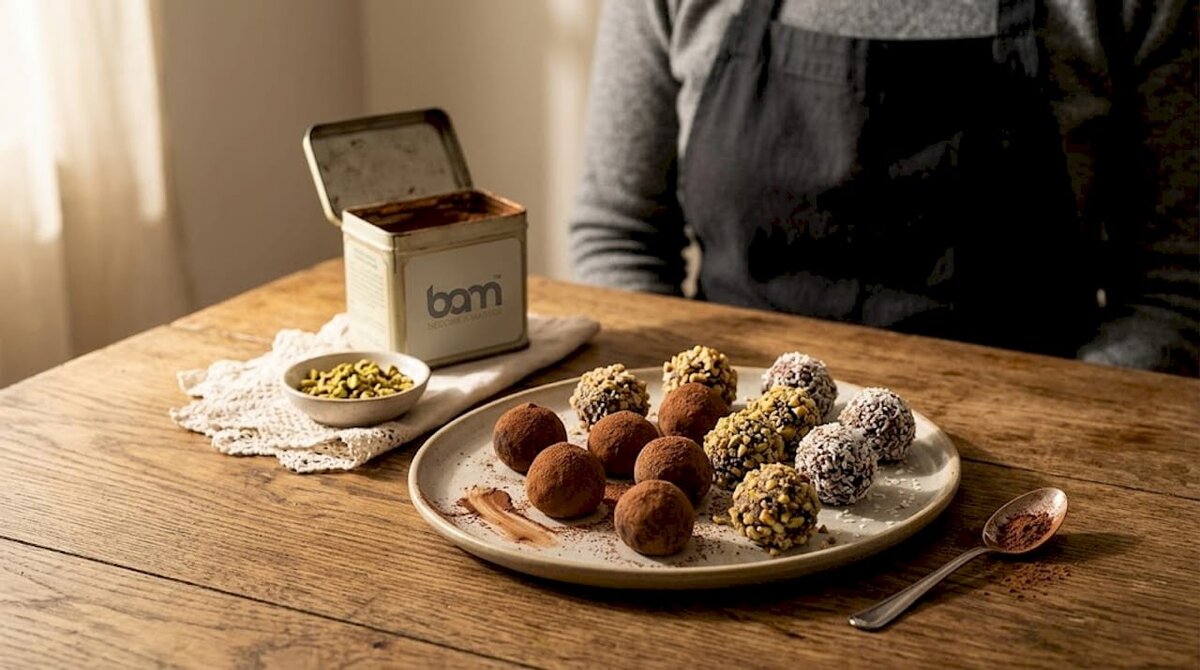
Pro Tip: Sift your cocoa powder before rolling to avoid clumps on the finished truffle. Dutch-processed cocoa gives a darker, less bitter coating than natural cocoa.
Learning how to make chocolate truffles is largely a matter of understanding the ganache process and respecting temperature at every stage. The steps below apply to a standard dark chocolate truffle.
Pro Tip: Cold hands prevent ganache from melting during rolling. Run your hands under cold water and dry them thoroughly before shaping, or wear food-safe gloves. Work in small batches and return the ganache to the fridge if it softens.
Chilling ganache overnight without freezing is the single most important technique tip. Freezing causes the ganache to harden unevenly and can introduce moisture when it thaws, which breaks the emulsion and produces a greasy, grainy texture.
Chocolate truffles are one of the most approachable luxury confections for home cooks when these steps are followed carefully. The process takes time but very little active effort.
One of the most appealing aspects of making truffles at home is how readily the base recipe adapts. The core ganache stays the same; what changes is what you put into it and what you roll it in.
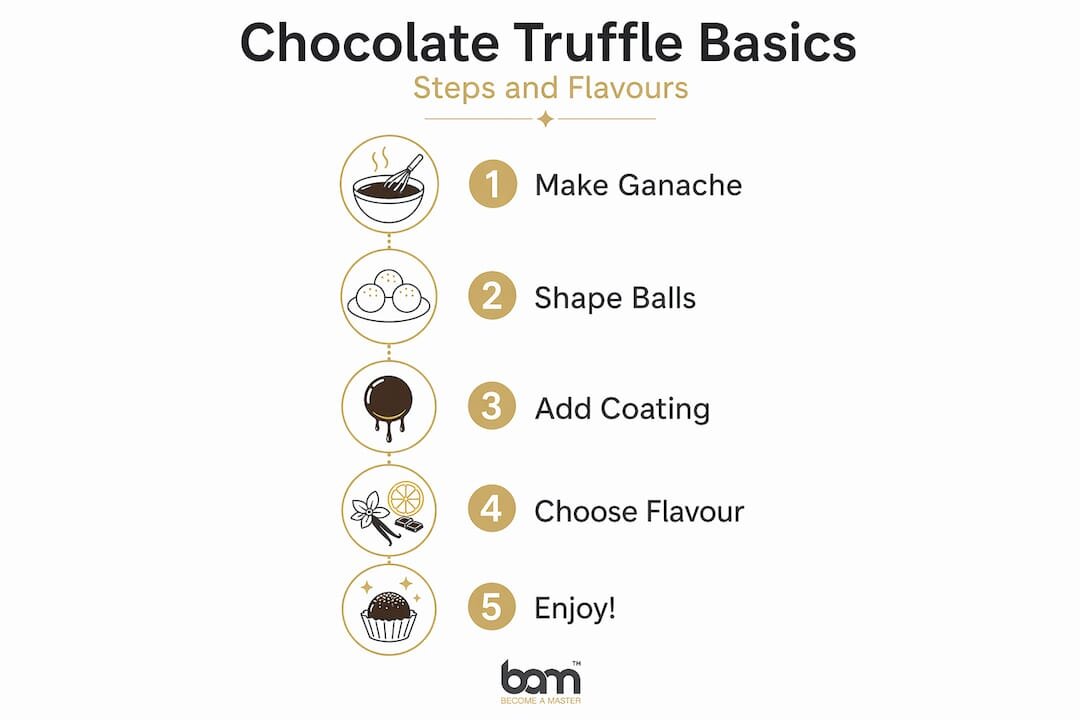
Incorporating flavourings directly into the warm ganache is the most effective approach. Steep fresh herbs like rosemary or mint in the cream before adding it to the chocolate for a subtle infusion. Add citrus zest for brightness. Swirl in nut butters for richness. The ganache absorbs flavour well at the warm stage, so this is the moment to experiment.
| Coating | Flavour profile | Best paired with |
|---|---|---|
| Cocoa powder | Bitter, dry, classic | Dark chocolate ganache |
| Chopped hazelnuts | Nutty, crunchy | Milk or praline ganache |
| Desiccated coconut | Sweet, tropical | White or rum ganache |
| Tempered chocolate shell | Smooth, snappy | Any ganache flavour |
| Icing sugar | Sweet, delicate | Lighter or fruit-infused ganache |
| Freeze-dried raspberry powder | Tart, vibrant | Dark or white chocolate ganache |
Presentation transforms truffles from a snack into a gift. Arrange them in small paper cases inside a rigid box lined with tissue paper. Mix coatings for visual variety. You can find inspiration for creative chocolate gift ideas that translate well to homemade truffle presentation.
Truffles also work as baking ingredients. Chop them roughly and fold into brownie batter before baking, or place a whole truffle in the centre of a cupcake before it goes into the oven. The ganache melts during baking and creates a molten centre. It is a straightforward technique with a dramatic result.
Proper storage preserves both the flavour and texture of your truffles. A few simple steps make a meaningful difference.
For longer-term storage guidance beyond the truffle itself, the advice on storing chocolate correctly applies equally to your raw ingredients.
I have made chocolate truffles dozens of times, and the thing I keep coming back to is how much the ingredient quality matters compared to technique. You can follow every step perfectly and still produce a mediocre truffle if you use low-grade chocolate or thin cream.
The most common mistake I see from beginners is using chocolate chips. I understand the appeal. They are convenient and already portioned. But the stabilisers in chips produce a ganache that never quite comes together. It sets, but it has a slightly waxy texture that you cannot fix after the fact. Switching to a good baking chocolate, something with a clean ingredient list and a proper cocoa percentage, changes the result entirely.
The other thing I would push back on is the idea that you need to be precise about every measurement. Ganache is more forgiving than most people think. If you add a little too much cream, you get a softer ganache that needs longer chilling. Too little cream and it firms up faster. Neither outcome ruins the batch. Adjust, chill, and carry on.
What I find genuinely satisfying about truffles is that they reward patience more than skill. You can learn the technique in one afternoon. The ganache fundamentals are not complicated. What separates good truffles from great ones is simply taking the time to use quality ingredients, chill properly, and not rush the rolling stage.
— Andraz
If you are ready to move from reading to making, Bamchocolate has the ingredients and tools to support every stage of the process. The baking accessories range includes the practical items that make truffle making cleaner and more consistent, from portioning tools to dipping forks and silicone moulds.
For those who want a curated starting point, the BAM Basic pastry package brings together the core supplies in one place. If you want to go further with flavour, the creamy fillings set and the exotic fillings set offer ready-to-use options that work beautifully as truffle centres or as inspiration for your own ganache variations. Bamchocolate also stocks premium baking chocolate suited to the 60 to 70% cocoa range that experts recommend, so you are not left guessing at the ingredient stage.
A chocolate truffle is made from a ganache centre of chocolate and cream, optionally enriched with butter or liqueurs, and coated in cocoa powder, chopped nuts, coconut, or a chocolate shell.
They are named after the truffle fungus because their rough, irregular shape closely resembles it. Louis Dufour first made them in 1895 and the name has remained ever since.
Melt finely chopped chocolate with hot cream to form ganache, chill overnight in the refrigerator, then roll into balls and coat in your chosen topping. Using high-quality baking chocolate and cream with at least 30% fat gives the best result.
Stored in an airtight container in the refrigerator, most truffles keep well for up to two weeks. Bring them to room temperature for 15 to 20 minutes before serving for the best texture.
Freezing is not recommended for ganache-based truffles. It causes uneven hardening and can break the emulsion when thawed, resulting in a greasy or grainy texture. Refrigeration is the correct storage method.



 Confectionery tips


 Slovenščina
 Hrvatski
 Deutsch
 Italiano
 Česky
Česky
 Polski
 Magyar
 Français
 Slovák
 Nederlands
 Español