 info@bamchocolate.com
  Login
Login 

 en
en 
 BAM Cake converter
  Login
Login Claudia
Avtorica vsebin


 Reading time:
10 minutes
Reading time:
10 minutes 
Unlock the role of sugar substitutes in baking with this practical guide. Learn how to enhance flavor and texture while reducing sugar today!
TL;DR:
- Sugar substitutes are essential in baking because they replicate sugar’s five key functions: sweetness, moisture retention, browning, crumb structure, and yeast fermentation support. Successfully using these substitutes requires adjustments in temperature, liquids, and blending to achieve proper texture, color, and shelf life; missteps often lead to dry, pale, or dense baked goods. Safety considerations vary, with natural options like honey being more heat-stable, while some artificial sweeteners like sucralose may degrade at high temperatures, affecting food safety and quality.
Sugar substitutes serve multiple functional roles in baking beyond sweetness, affecting moisture retention, crumb structure, browning reactions, and yeast fermentation. The industry term for this area is “functional sweetener replacement,” and understanding it is the difference between a successful bake and a dry, pale, structurally weak result. Whether you are reducing sugar for health reasons or experimenting with natural sweeteners in baking, the substitutes you choose must replicate all of sugar’s jobs, not just the taste. This guide covers the role of sugar substitutes in baking from a science-grounded, practical perspective, drawing on 2026 research and food safety guidance from EFSA and leading baking institutions.
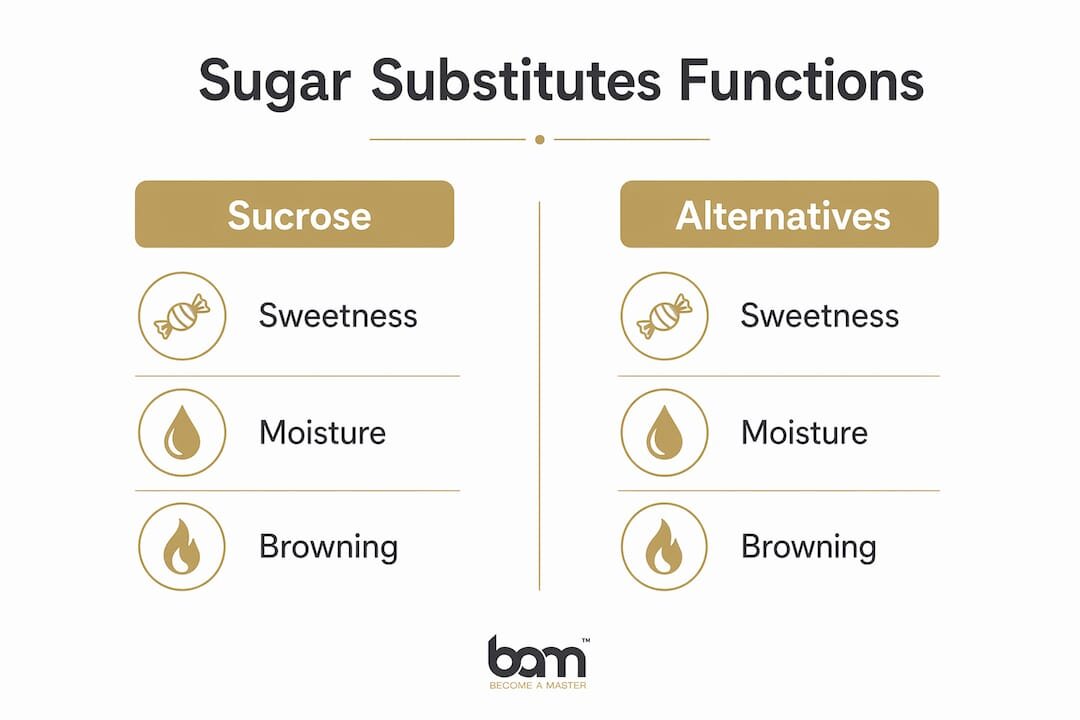
Sugar’s five key functional roles in baking are sweetness, moisture retention, browning, crumb structure, and fermentation support. Most home bakers know about sweetness. Far fewer account for the other four, which is precisely why so many sugar-free bakes disappoint.
Browning in baked goods comes from two reactions: the Maillard reaction between sugars and proteins, and caramelisation of sugars at high heat. Remove sucrose without a functional replacement and your biscuits come out pale, your cakes look underbaked, and your crusts lack that golden colour. Moisture retention is equally critical. Sugar is hygroscopic, meaning it attracts and holds water. This keeps cakes soft for days after baking. Without it, baked goods dry out faster and feel dense or crumbly on the palate.
Structure is the third hidden role. Sugar interferes with gluten development and protein coagulation, which produces a tender crumb rather than a tough one. In yeast-based recipes, sugar also acts as a fermentable carbohydrate, feeding the yeast and producing the carbon dioxide that makes dough rise. Removing sugar without replacement leads to longer proof times, reduced volume, and a denser crumb.
The table below shows how the most common substitute categories compare against sucrose across these five functions.
| Function | Sucrose | Artificial sweeteners | Sugar alcohols (e.g. erythritol, xylitol) | Natural sweeteners (e.g. honey, agave) |
|---|---|---|---|---|
| Sweetness | High | Very high | Moderate | Moderate to high |
| Moisture retention | High | None | Moderate (humectant) | High |
| Browning | Yes (Maillard + caramelisation) | Minimal | Limited | Yes (faster with fructose) |
| Crumb structure/bulk | Full | None | Partial | Partial |
| Yeast fermentation | Yes | No | Minimal | Yes (honey, agave) |
Pro Tip: If you are using an artificial sweetener like sucralose or stevia as your only substitute, add a small amount of inulin or psyllium husk to compensate for the missing bulk and moisture retention.
The impact of sweeteners in baking on texture is often the first problem home bakers notice. Dryness, a gummy crumb, or reduced volume are the most common complaints, and they all trace back to water-binding differences between sucrose and its replacements.
Here is what changes when you swap sugar for an alternative:
A 2026 university study found large differences in acrylamide and 5-HMF levels in whole-grain wheat cookies baked with different sweeteners. This matters because both compounds form during high-heat baking and have implications for both flavour bitterness and food safety. Sugar alcohols and stevia produced significantly lower levels than fructose-based substitutes.
Pro Tip: When baking with allulose, reduce your oven temperature by 10 to 15°C and check for doneness 5 to 10 minutes earlier than the recipe states. This prevents over-browning on the outside while the interior finishes cooking.
Successful sugar substitute baking follows a clear set of practical rules. Pastry-focused conversion guidance from the International Culinary Center recommends starting with near 1:1 ratios for most substitutes, then adjusting sweetness by taste from there. Here is a step-by-step framework for adapting any recipe:
Pro Tip: For sugar substitutes for cookies specifically, try a blend of 70% erythritol and 30% allulose. Erythritol provides structure and sweetness; allulose contributes moisture and a light golden colour without burning.
Safety in sugar substitute baking depends on the specific compound and the temperatures involved. Not all substitutes behave the same way under oven conditions, and some carry more uncertainty than others at high heat.
EFSA’s 2026 re-evaluation confirmed that sucralose is safe at authorised use levels, but it flagged uncertainty around prolonged high-temperature baking in domestic settings. At temperatures above 120°C, sucralose can degrade and potentially release chlorine-containing compounds. This does not mean sucralose is dangerous in a single batch of biscuits, but it does mean it is not the best choice for recipes requiring extended baking at high heat.
The table below summarises the safety and suitability profile of common substitutes for home baking.
| Substitute | Heat stability | Browning | Safety notes | Best for |
|---|---|---|---|---|
| Erythritol | High | Low | Well-tolerated; may cause digestive discomfort in large amounts | Cookies, icings, cheesecakes |
| Xylitol | Moderate | Low | Toxic to dogs; safe for humans at moderate levels | Muffins, soft cakes |
| Allulose | Moderate | Very high | Generally recognised as safe; monitor browning carefully | Caramel, cookies, brownies |
| Stevia | High | Very low | Safe; bitter at high concentrations | Light sponges, drinks |
| Sucralose | Low at high heat | Low | Uncertainty above 120°C with prolonged baking | Cold desserts, light bakes |
| Honey / agave | Moderate | High (fructose) | Natural; higher calorie than some substitutes | Breads, granola, spiced cakes |
Natural sweeteners such as honey and agave are generally the most straightforward choice for home bakers who want to understand why natural options differ from refined sugar. They provide functional bulk, moisture, and browning, though their calorie content is comparable to sucrose. For genuinely low-calorie baking, erythritol or a stevia blend remains the most practical and well-researched option.
Sugar substitutes must replace all five functional roles of sucrose, not just sweetness, to produce baked goods with the correct texture, colour, and shelf life.
| Point | Details |
|---|---|
| Sugar has five functions | Sweetness, moisture, browning, structure, and yeast fermentation all need addressing when substituting. |
| Allulose browns fast | Reduce oven temperature by 10 to 15°C and check bakes early to prevent over-browning. |
| Moisture is the primary challenge | Failures in sugar-free baking most often come from ignoring water-binding, not sweetness mismatch. |
| Blend substitutes for best results | Combining erythritol with inulin or allulose improves both texture and colour in most recipes. |
| Sucralose needs caution at high heat | EFSA’s 2026 guidance flags uncertainty for sucralose used in prolonged high-temperature domestic baking. |
The single biggest mistake I see home bakers make is treating sugar substitutes as a direct swap. You change the sweetener, the recipe looks the same on paper, and then the cake comes out dry, pale, and oddly dense. The problem is not the substitute itself. The problem is that nobody told you sugar was doing five jobs at once.
My honest experience is that moisture management is where most bakes succeed or fail. I have had far better results adding a tablespoon of glycerol or an extra egg yolk to compensate for lost humectancy than I ever did by simply increasing the amount of erythritol. The texture difference is immediate and obvious.
I am also cautious about the trend of using sucralose in everything. The EFSA guidance on high-heat baking is not alarmist, but it is worth taking seriously. For anything baked above 150°C for more than 20 minutes, I reach for erythritol, allulose, or a natural sweetener instead. The health benefits of sugar alternatives are real, but they are best realised when you choose the right substitute for the right application.
The good news is that once you understand the functional chemistry, the adjustments become second nature. Start with a blend, control your oven temperature, and taste as you go. Baking with sugar alternatives is not a compromise. It is a different skill set, and one worth developing properly.
— Andraz
Bamchocolate stocks a curated range of baking additives and accessories designed to support exactly the kind of adjustments this article describes. From texture-improving agents to moisture-retaining ingredients, the range covers the gaps that sugar substitutes leave behind. For home bakers who want a structured starting point, the 101 BAM pastry recipe book includes recipes developed with sugar alternatives and premium ingredients, taking the guesswork out of conversion. If you are building your pantry from scratch, the BAM Basic pastry package provides the core components for healthier confectionery at home.
Sugar substitutes must replicate sugar’s five functions: sweetness, moisture retention, browning, crumb structure, and yeast fermentation support. Replacing only the sweetness without addressing the other roles produces dry, pale, or structurally weak baked goods.
Stevia provides sweetness but no bulk, moisture, or browning. Using it alone results in flat, pale bakes with a dry texture. Combining stevia with a bulking agent such as erythritol or inulin produces far better results.
Allulose is generally recognised as safe, but it caramelises at a much lower temperature than sucrose, starting at around 100 to 110°C. Reducing oven temperature by 10 to 15°C prevents over-browning and burning before the interior is fully cooked.
Yes. Agave syrup adds significant moisture due to its high fructose content and liquid form. Reducing other liquids in the recipe by approximately 60ml per 240ml of agave used compensates for this and prevents an overly wet crumb.
EFSA’s 2026 re-evaluation confirmed sucralose is safe at authorised use levels, but flagged uncertainty for prolonged baking above 120°C in domestic settings. For high-heat recipes, erythritol or natural sweeteners are a more straightforward choice.



 Confectionery tips



 Slovenščina
 Hrvatski
 Deutsch
 Italiano
 Česky
Česky
 Polski
 Magyar
 Français
 Slovák
 Nederlands
 Español