 info@bamchocolate.com
  Login
Login 

 en
en 
 BAM Cake converter
  Login
Login Claudia
Avtorica vsebin


 Reading time:
11 minutes
Reading time:
11 minutes 
Discover what allergen-friendly baking is and master safe, delicious treats for all. Learn techniques to create tasty, allergy-safe baked goods!
TL;DR:
- Allergen-friendly baking involves preparing baked goods that omit major allergens and prevent cross-contact during handling. It relies on understanding labels, using dedicated equipment, and selecting substitutes that mimic the original ingredients’ functions to ensure safety and desired texture. Strict kitchen hygiene and careful ingredient verification are essential to minimize allergen transfer and produce genuinely safe treats.
Allergen-friendly baking is the practice of preparing baked goods that deliberately exclude major allergenic ingredients and employ techniques to prevent allergen cross-contact, making treats safer for people with food allergies or dietary restrictions. Also referred to in professional contexts as “free-from baking,” this approach covers far more than swapping one ingredient for another. It requires understanding labelling, managing your kitchen environment, and choosing substitutions that preserve texture and flavour. The FDA’s nine major allergens now include milk, eggs, fish, shellfish, tree nuts, wheat, peanuts, soybeans, and sesame, giving home bakers a clear framework for what to watch on every label.
Allergen-friendly baking covers any baking approach that removes or significantly reduces one or more major allergens from a recipe while also controlling the risk of cross-contact during preparation. The term is widely used but carries an important caveat: “allergy-friendly” is not legally defined in most regions, including the UK and the US. Two products both labelled “allergy-friendly” may avoid entirely different allergens and carry different levels of cross-contact risk. That inconsistency is the single most important thing a home baker needs to understand before trusting any label.
The nine allergens now required on US food labels under the FASTER Act provide a useful checklist regardless of where you bake. Sesame was added to the list in 2023, reflecting growing clinical evidence of its allergenic potential. In the UK, the Food Standards Agency mandates declaration of 14 allergens, which additionally covers celery, mustard, lupin, molluscs, and sulphur dioxide. Knowing both frameworks helps you read imported ingredient packaging accurately.
When selecting ingredients, focus on three label elements in this order:
Pro Tip: Certified allergen-free ingredients, such as those carrying GFCO (Gluten-Free Certification Organisation) or AOECS (Association of European Coeliac Societies) marks, have been independently verified. They are worth the extra cost when baking for someone with a diagnosed allergy.
Cross-contact occurs when allergenic proteins transfer from one food or surface to another, and it is distinct from microbial contamination. Cooking does not destroy allergen proteins, so thorough separation and cleaning are the only reliable controls. A reaction from cross-contact can range from mild hives to anaphylaxis, making kitchen hygiene as critical as the recipe itself.
The Cleveland Clinic advises thorough handwashing, cleaning all surfaces, and using separate cutting boards and utensils as baseline steps. In a home kitchen where allergen-containing and allergen-free baking happen in the same space, you need a more structured approach.
Follow these steps before starting any allergen-free bake:
Airborne allergen particles are a less obvious but real risk. Flour dust disperses during dry mixing and can settle on surfaces and utensils across the kitchen. If you are baking gluten-free goods in a kitchen where wheat flour is regularly used, open windows, work in a cleared area, and allow dust to settle before beginning your allergen-free preparation.
| Cross-contact risk | Prevention method |
|---|---|
| Shared surfaces | Clean with hot soapy water before each allergen-free session |
| Shared utensils and tins | Use dedicated, labelled allergen-free equipment |
| Airborne flour dust | Ventilate the kitchen and allow dust to settle before starting |
| Ingredient storage | Store allergen-free ingredients in sealed, separate containers |
| Hand transfer | Wash hands before handling any allergen-free ingredient |
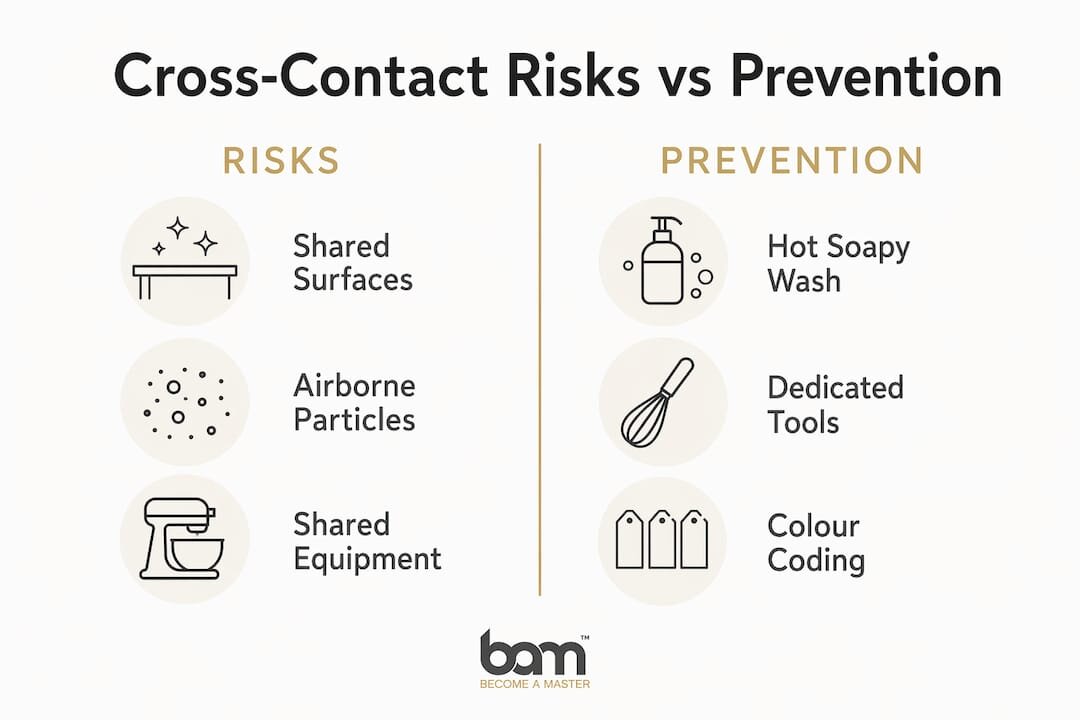
Pro Tip: Label your dedicated allergen-free equipment with coloured tape or stickers. A simple colour-coding system removes any guesswork when multiple people use the same kitchen.
Allergen-controlled professional operations often eliminate allergens entirely through dedicated facilities rather than relying on cleaning alone. That is not realistic for most home kitchens, but it underlines why cleaning protocols must be thorough and consistent rather than occasional.
Successful baking without allergens depends on understanding what each allergenic ingredient actually does in a recipe, then finding a substitute that performs the same function. Gluten-free flour blends combine starches, fibres, hydrocolloids such as xanthan gum or guar gum, and proteins to replicate the binding and elasticity that gluten provides. A single-flour swap, such as replacing plain wheat flour with rice flour alone, rarely produces acceptable results.
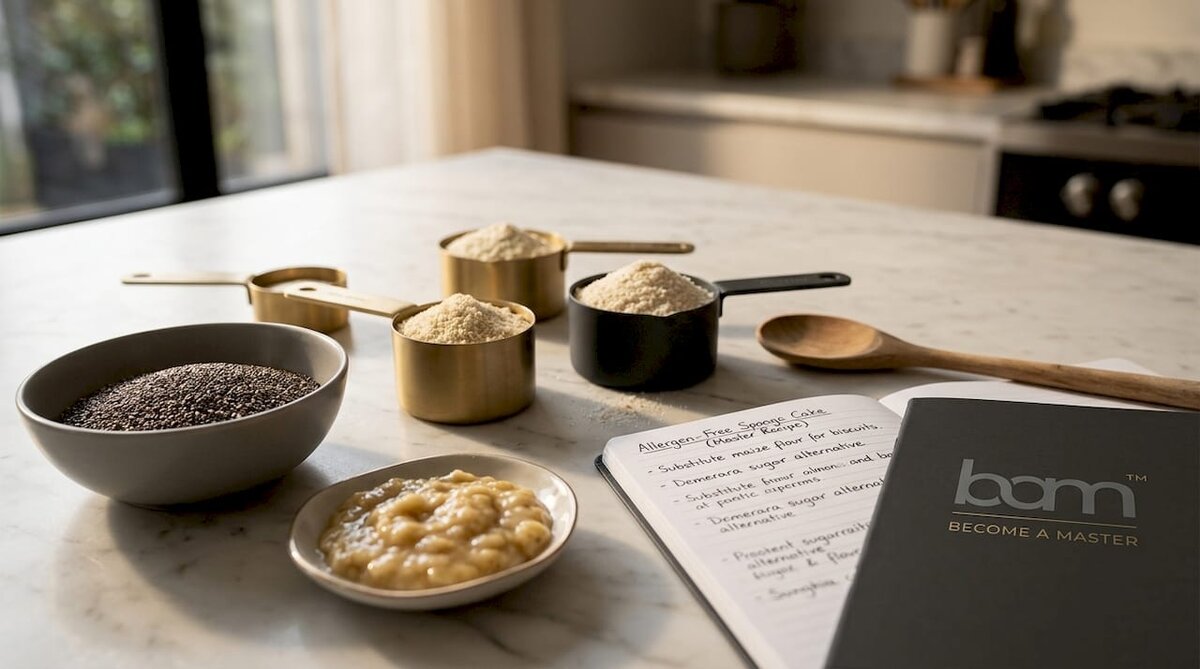
Here is a practical comparison of common allergens and their most reliable substitutes:
| Allergen | Function in baking | Substitute options |
|---|---|---|
| Eggs | Binding, leavening, moisture | Flaxseed meal mixed with water, applesauce, commercial egg replacers such as Bob’s Red Mill Egg Replacer |
| Wheat/gluten | Structure, elasticity | Certified gluten-free flour blends with xanthan gum or guar gum |
| Dairy (butter) | Fat, flavour, tenderness | Coconut oil, dairy-free block margarine such as Naturli Vegan Block |
| Dairy (milk) | Moisture, flavour | Oat milk, soy milk, coconut milk |
| Tree nuts | Texture, fat, flavour | Sunflower seeds, pumpkin seeds, toasted oats |
A few points worth noting on each category:
Ingredient blends with xanthan, HPMC, and emulsifiers significantly improve the quality of gluten-free products compared to single-ingredient substitutions. This is why buying a purpose-formulated gluten-free blend almost always outperforms building your own from scratch unless you have considerable experience with the ratios involved.
Pro Tip: When adapting a standard recipe for vegan baking substitutions, change one allergen at a time if possible. Replacing eggs, dairy, and gluten simultaneously in a first attempt makes it very difficult to identify which substitution caused a texture or flavour problem.
Allergen-free recipes work across the full range of home baking, from everyday biscuits and muffins to celebration cakes and holiday bakes. The key is selecting recipes that are naturally close to allergen-free, then making targeted adjustments rather than attempting a complete overhaul of a complex recipe.
Practical starting points include:
Shopping for allergen-free ingredients has become considerably easier. Specialist retailers and online platforms now stock certified gluten-free flours, dairy-free chocolates, and egg replacers alongside mainstream baking supplies. When buying online, filter by dietary certification rather than relying on product names alone. For multiple-allergen households, buying in bulk from a single certified supplier reduces the risk of introducing new cross-contact variables.
Allergen-friendly baking requires equal attention to ingredient substitution, label verification, and cross-contact prevention to produce baked goods that are genuinely safe for people with food allergies.
| Point | Details |
|---|---|
| Labelling is not standardised | “Allergy-friendly” has no legal definition; always read the full ingredients list and “Contains” statement. |
| Cross-contact is the hidden risk | Allergen proteins transfer via surfaces, utensils, and airborne dust; cleaning and dedicated equipment are non-negotiable. |
| Substitutions require function-matching | Replace each allergen with an ingredient that performs the same structural or moisture role, not just a similar flavour. |
| Gluten-free needs blends, not single flours | Certified gluten-free flour blends with xanthan gum consistently outperform single-flour substitutions for texture and rise. |
| Certification marks add reliability | GFCO and AOECS marks on ingredients confirm independent verification beyond manufacturer claims. |
From my experience working with home bakers on allergen-aware projects, the most common mistake is treating allergen-friendly baking as purely a recipe problem. Bakers spend considerable effort sourcing the right flour blend or egg replacer, then use the same unwashed mixing bowl they used for a walnut cake the day before. The substitution was correct. The process was not.
The uncomfortable truth is that allergen-free labelling claims on commercial products are voluntary and carry no guarantee of zero cross-contact. If manufacturers with dedicated facilities and testing programmes cannot always guarantee full allergen exclusion, a home kitchen with shared equipment carries a meaningful risk unless hygiene protocols are followed consistently. That is not a reason to avoid allergen-friendly baking. It is a reason to take the kitchen management side as seriously as the recipe side.
I also think the allergy community is underserved by the volume of content that focuses on ingredient swaps while barely mentioning cross-contact. A beautifully made gluten-free cake baked in a tin that previously held a wheat sponge is not a safe product for a coeliac. The recipe was right. The process failed. Getting both right, every time, is what allergen-friendly baking actually means.
— Andraz
Bamchocolate stocks a range of baking accessories suited to allergen-friendly kitchen set-ups, including precision tools that support hygienic, accurate baking. Dedicated equipment is one of the most practical investments for anyone baking regularly without allergens, and having the right tools makes the process noticeably more consistent. For recipe inspiration, the BAM Basic pastry package and the 101 BAM pastry recipe collection both offer a broad range of pastry ideas adaptable to free-from requirements. Browse the full range at Bamchocolate to find ingredients and accessories that support safer, more confident baking.
Allergen-friendly baking is the practice of preparing baked goods that exclude one or more major allergenic ingredients and use techniques to prevent cross-contact during preparation. The term has no single legal definition, so the specific allergens excluded vary by recipe or product.
The nine major allergens most commonly avoided are milk, eggs, fish, shellfish, tree nuts, wheat, peanuts, soybeans, and sesame. UK regulations additionally cover celery, mustard, lupin, molluscs, and sulphur dioxide.
Cross-contact prevention requires cleaning all surfaces and equipment thoroughly before each allergen-free bake, using dedicated labelled utensils, and storing allergen-free ingredients separately. Airborne flour dust is also a risk and should be managed through ventilation and allowing dust to settle before starting.
Flaxseed meal mixed with water works well in dense bakes, while commercial egg replacers such as Bob’s Red Mill Egg Replacer perform reliably across a wider range of recipes. The best choice depends on the recipe type and the structural role eggs play in it.
Gluten-free flour blends combine starches, fibres, and hydrocolloids such as xanthan gum to replicate gluten’s binding and elasticity. They do not behave identically to plain flour, so recipes often need slightly more liquid and a lower baking temperature for best results.




 Confectionery tips



 Slovenščina
 Hrvatski
 Deutsch
 Italiano
 Česky
Česky
 Polski
 Magyar
 Français
 Slovák
 Nederlands
 Español