 info@bamchocolate.com
  Login
Login 

 en
en 
 BAM Cake converter
  Login
Login Claudia
Avtorica vsebin


 Reading time:
10 minutes
Reading time:
10 minutes 
Discover what white chocolate really is, its unique composition, and versatile uses in baking. Uncover its secrets today!
TL;DR:
- White chocolate contains cocoa butter but no cocoa solids, linking it to the chocolate family despite its different composition. Its quality varies based on cocoa butter purity, and it requires careful melting and tempering techniques for optimal use in baking. Recognizing genuine white chocolate and handling it properly unlocks its versatility as an ingredient for delicate, flavourful confections.
White chocolate divides opinion like few other confectionery products. Ask a pastry chef whether it counts as real chocolate and you will likely spark a debate. What is white chocolate, exactly? The short answer is that it contains no cocoa solids, yet it is derived from the cocoa bean through its primary ingredient: cocoa butter. Understanding its composition, how it is produced, and how it behaves in the kitchen transforms it from a misunderstood ingredient into one of the most versatile tools in a baker’s repertoire.
| Point | Details |
|---|---|
| White chocolate contains cocoa butter | Cocoa butter, extracted from cocoa beans, is the ingredient that connects white chocolate to the broader chocolate family. |
| Legal standards define it | The FDA requires at least 20% cocoa butter, 14% milk solids, and no more than 55% sugar for a product to be labelled white chocolate. |
| No cocoa solids present | The absence of cocoa solids means white chocolate has no bitterness and a distinctly creamy, sweet flavour profile. |
| Melting requires care | White chocolate burns easily and should never be melted above 45°C; a bain-marie is the safest method. |
| Quality varies significantly | Premium white chocolate uses non-deodorised cocoa butter, which delivers subtle aroma and complexity that cheaper alternatives lack. |
The question of whether white chocolate is real chocolate comes down to one ingredient: cocoa butter. White chocolate contains no cocoa solids; it is made from cocoa butter, sugar, milk solids, vanilla, and lecithin. Because cocoa butter is extracted directly from cocoa beans, white chocolate maintains a legitimate connection to the chocolate family, even without the brown paste most people associate with the word.
The white chocolate ingredients list is straightforward, but each component plays a specific role:
Legal definitions matter here, particularly when you are buying white chocolate for baking. The FDA requires at least 20% cocoa butter, 14% total milk solids, and 3.5% milkfat, with sugar capped at 55%. Artificial colouring is prohibited and emulsifiers are limited to 1.5% of formula weight. Products that do not meet these standards cannot legally be labelled white chocolate in the US.
The distinction matters in practice. Many cheaper coatings replace cocoa butter with vegetable fats such as palm oil or coconut oil. These products behave differently when melted, taste noticeably flatter, and will not temper correctly. When a recipe calls for white chocolate, using a confectionery coating instead produces inferior results.
| Feature | White chocolate | Confectionery coating |
|---|---|---|
| Main fat | Cocoa butter | Vegetable fat |
| Legal label | Yes, if standards met | Cannot be labelled white chocolate |
| Tempering | Yes, possible | No |
| Flavour | Creamy, complex | Flat, waxy |
Understanding how white chocolate is made clarifies why quality varies so much between brands. The process shares some steps with milk and dark chocolate production, but the absence of cocoa mass changes the dynamics considerably.
The conching stage deserves particular attention. In dark chocolate production, conching develops complex flavour compounds through oxidation and evaporation. With white chocolate, the goal is preservation rather than development. Keeping temperatures low protects the delicate ivory colour and prevents the milk solids from caramelising prematurely.
High-quality white chocolate uses non-deodorised cocoa butter, which retains subtle, natural chocolate aromas. Budget products strip the cocoa butter of its aroma entirely and compensate with artificial vanilla flavouring. The difference is noticeable in both smell and taste.
Pro Tip: When buying white chocolate for baking, check whether the label specifies “cocoa butter” as the fat source. If it lists vegetable fat or palm oil instead, you are looking at a coating product, not genuine white chocolate.
White chocolate’s flavour profile is unlike any other chocolate type. With no cocoa solids present, there is no bitterness, no roasted depth, and no astringency. What you get instead is a combination of sweet creaminess, mild vanilla, and a rich, fatty mouthfeel that coats the palate.
Sugar’s role goes beyond sweetness. At concentrations of 45 to 55%, it contributes structurally to the texture, creating that characteristic density and melt. The milk fats add a buttery quality that distinguishes white chocolate from other sweet confections.
The most common criticisms of white chocolate are that it is too sweet and lacks complexity. These criticisms are often valid for low-quality products. Premium white chocolate, made with non-deodorised cocoa butter, offers genuine aromatic nuance. You will detect faint floral and dairy notes that cheaper versions simply do not have.
White chocolate makes up the least popular traditional chocolate type, yet its mild, creamy character makes it the most adaptable canvas for pairing with bold flavours like matcha, raspberry, or passion fruit.
Its ivory colour comes directly from cocoa butter and milk solids. There are no added colourings in genuine white chocolate. The shade can range from pale cream to a deeper ivory depending on the milk solids used and the conching conditions.
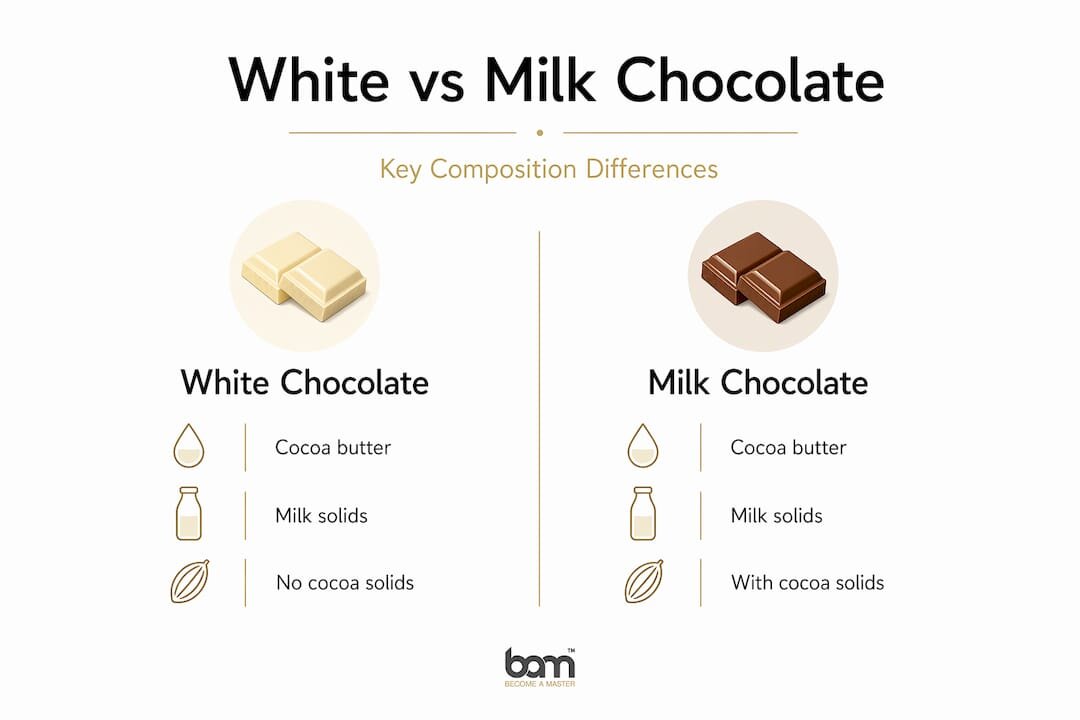
White chocolate vs milk chocolate is a comparison worth making clearly. Milk chocolate contains cocoa solids alongside cocoa butter and milk, giving it a fuller chocolate flavour with moderate sweetness. White chocolate has no cocoa solids at all, making it sweeter, creamier, and more neutral in flavour. Both contain cocoa butter, but the presence or absence of cocoa solids defines the sensory experience entirely.
White chocolate is one of the more demanding ingredients to work with in a professional or home kitchen. Its high sugar and milk solids content make it more sensitive to heat than dark or milk chocolate, and small errors in temperature lead to visible, textural problems.
White chocolate melts at a lower temperature, roughly 38 to 43°C, compared to dark chocolate. This means it can scorch quickly if you are not paying attention. The recommended approach is a bain-marie: place a heatproof bowl over a pan of barely simmering water, add chopped white chocolate, and stir gently. Never let the bowl touch the water and never exceed 45°C.
Key points for melting and using white chocolate in desserts:
Tempering is where white chocolate becomes genuinely challenging. Small temperature deviations of 2 to 3°C can result in dull surfaces or a grainy, crumbly texture. The tempering curve for white chocolate is typically: melt to 40 to 45°C, cool to 25 to 26°C, then reheat gently to 27 to 28°C before use. This is a narrower window than dark chocolate, which tolerates a degree or two of variation more forgivingly.
Storage is another area where white chocolate needs specific attention. White chocolate easily absorbs environmental odours due to its high fat content. Store it in an airtight, opaque container away from strong-smelling foods like coffee, cheese, or spices. A cool, dry cupboard is preferable to the refrigerator, where condensation can cause sugar bloom on the surface.
Pro Tip: If your white chocolate has developed a chalky or streaky appearance, it has likely bloomed. It is still safe to eat and will melt normally, but it will not set with a glossy finish unless you re-temper it properly.
For practical guidance on handling white chocolate in the kitchen, including melting and tempering techniques, Bamchocolate’s resource section covers the process in detail.
I have worked with white chocolate long enough to understand why it frustrates people. It burns faster than dark chocolate, blooms if you look at it the wrong way, and a significant portion of what is sold in supermarkets barely qualifies as the real thing. Those frustrations are legitimate. But they are also entirely avoidable once you understand the ingredient.
In my experience, the single biggest factor separating a good white chocolate experience from a bad one is cocoa butter quality. I have used products where the cocoa butter was clearly deodorised and the vanilla flavouring was doing all the heavy lifting. The result was flat and cloying. Switch to a product that lists non-deodorised cocoa butter and the difference is immediate. There is a faint, almost floral complexity that makes white chocolate worth using on its own terms, not just as a sweet backdrop.
What I find most interesting about white chocolate in cooking is how well it pairs with acidic and aromatic flavours. Matcha, yuzu, raspberry, and lavender all work exceptionally well because white chocolate’s neutrality amplifies rather than competes. Dark chocolate can overpower delicate flavours; white chocolate lets them lead.
My advice: stop treating white chocolate as a lesser option. Treat it as a different tool with different strengths. Once you do, it becomes one of the most useful things in your kitchen.
— Andraz
If you are ready to put white chocolate to work in your kitchen, Bamchocolate has the products to support serious baking and confectionery projects. The BAM Confectionery set Creamy fillings pairs exceptionally well with white chocolate bases, offering ready-to-use fillings that complement white chocolate’s creamy profile in bonbons, tarts, and layered cakes. For those building out a full confectionery toolkit, the BAM Large Confectionery Bundle provides an extensive range of products suited to working across all chocolate types. You will also find a full selection of baking accessories to support melting, tempering, and moulding. Whether you are making your first white chocolate ganache or refining a multi-component pastry, Bamchocolate has the ingredients and tools to make it work.
White chocolate is considered a chocolate product because it contains cocoa butter, which is extracted from cocoa beans. However, it contains no cocoa solids, which is why some argue it does not qualify as true chocolate.
White chocolate is made from cocoa butter, sugar, milk solids, vanilla, and lecithin. Genuine white chocolate must contain at least 20% cocoa butter and 14% milk solids to meet legal standards.
Milk chocolate contains both cocoa solids and cocoa butter, giving it a fuller chocolate flavour. White chocolate contains only cocoa butter with no cocoa solids, making it sweeter and creamier with no bitterness.
White chocolate melts at a lower temperature than other chocolate types, around 38 to 43°C. Its high sugar and milk solids content make it particularly sensitive to heat, so a bain-marie and continuous stirring are strongly recommended.
Store white chocolate in an airtight, opaque container in a cool, dry place. Its high fat content means it absorbs environmental odours rapidly, so keeping it away from strong-smelling foods is important for preserving flavour quality.



 Confectionery tips



 Slovenščina
 Hrvatski
 Deutsch
 Italiano
 Česky
Česky
 Polski
 Magyar
 Français
 Slovák
 Nederlands
 Español