 info@bamchocolate.com
 Login


 en

 BAM Cake converter
 Login
Claudia
Avtorica vsebin


 Reading time:
9 minutes
Turn EU food contact rules and PPWR into clear decisions on materials, structure, labeling, and supplier requirements for your chocolate packaging.
Custom chocolate packaging must fit the finished product exactly, protect it through storage and shipping, satisfy EU food-contact law, and work towards recyclability under the Packaging and Packaging Waste Regulation. Every brief balances three trade-offs: cost, protection and sustainability. Get these right first, then build the branding on top.
The structure you choose depends on product size, shelf position and how long the chocolate needs to stay fresh. A single bar usually sits in a folding carton or a tray-and-sleeve combination, both of which protect against light and crushing while keeping unit cost low. Multipacks often use an outer sleeve over individually wrapped bars, which speeds up retail restocking. Praline assortments and gift ranges tend to need rigid boxes, sometimes with a windowed lid so the product sells itself on shelf.
Each structure changes how much it costs to fill, how it stacks on a pallet, and how long the chocolate stays within its ideal temperature band during transit.
Paperboard, foils, metalised films and cellulose-based films each behave differently once chocolate and recycling rules are factored in. Paperboard recycles easily in most European streams; metalised films and mixed laminates often don’t, because separating the layers isn’t viable at scale. Cellulose-based films offer a compostable alternative but need checking against local waste infrastructure before any claim goes on pack.
Materials intended to touch chocolate directly must comply with Regulation (EC) No 1935/2004, which requires that no constituent transfers into the food in quantities that could endanger health or change its taste and smell, and that the material carries proper labelling and traceability. Manufacturers of those materials must also follow the good manufacturing practice set out in Commission Regulation (EC) No 2023/2006, which governs how food-contact materials are produced so they don’t transfer unsafe substances under normal use.
Supplier checklist:
Food-contact materials carry legal traceability obligations under Regulation (EC) No 1935/2004, which means every supplier in the chain should be able to show where a material came from and what it’s made of.
Pack artwork has to do two jobs at once: stand out on a crowded shelf and carry every piece of mandatory information clearly. Ingredient lists, nutrition panels, allergen statements and legal text need a defined, uncluttered zone, usually on a side or back panel, so they never compete with the brand mark for attention.
Visual distinctiveness comes from colour, pattern and typography choices that are genuinely your own rather than borrowed from category leaders. Lookalike packaging invites confusion and disputes, so a brand’s colour palette, logo placement and pattern work should be checked against competitors before anything goes to print.
Artworking also has practical limits: bleed and safe zones stop text or logos being trimmed off, colour profiles need to match press capability (CMYK, not RGB), and resolution should sit at 300 dpi or above for any print element.
Pro Tip: Build your legal panel first, then design the brand graphics around it, not the other way round.
A clear brief avoids rework and gets you an accurate quote the first time. Before contacting a printer or packaging supplier, prepare the following.
Skipping the proof stage is the most common cause of a mismatched run arriving at the warehouse.
Measure the finished bar first (length by width by thickness), then measure the packed dimensions including any protective film or tray, since these two figures are rarely identical. Share the dieline with every structural element marked: glue flaps, fold lines, bleed allowance, barcode placement and the legal panel zone.
The most common dieline mistake is leaving bleed off text near a fold, which then prints cropped or shifted on the finished carton.
Regulation (EU) 2025/40, the Packaging and Packaging Waste Regulation, begins applying across the EU from 12 August 2026, and it sets out recyclability milestones brands need to plan against now. By 1 January 2030, packaging placed on the EU market must be recyclable in an economically viable way, and from 2038 it must meet at least grade B under the regulation’s performance scale.
Practical design actions follow directly from this:
By 1 January 2030, EU packaging must meet an economically viable recyclability standard under PPWR, which gives brands roughly four years from the regulation’s application date to adjust specifications.
Document recyclability claims with a supplier statement rather than a marketing assumption, and be cautious with compostable claims: most compostable films are only suited to industrial composting, not home bins, so labelling needs to say which.
Finishes carry most of the visual premium feel, and most of the recyclability risk. Hot foil and cold foil add metallic shine, embossing adds texture without colour, spot varnish highlights a logo or pattern, and windows let the product sell itself.
Choosing finishes with recycling in mind rarely costs more; it just means asking the right question before signing off the dieline.
Packaging is one of the few touchpoints a chocolate brand fully controls, and the choices in this guide — structure, material, finish, compound. A pack that protects well, reads clearly and recycles cleanly builds the kind of trust that brings a customer back for a second bar. For presentation ranges and premium formats, working with a specialist supplier gives a practical starting point for seeing these choices in finished form.
— Andraz
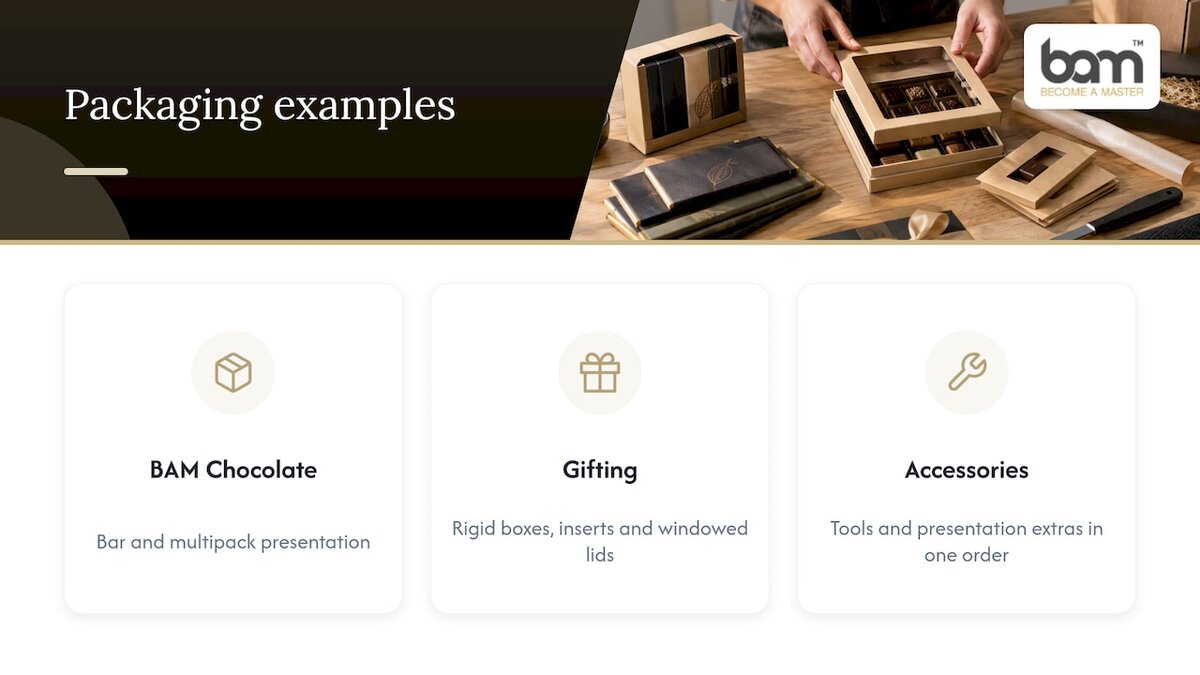
We stock finished formats that show these choices in practice rather than on paper. Our BAM Chocolate range demonstrates bar and multipack presentation across our own product lines, while our curated Gifts collection and BAMBox™ format show how rigid boxes, inserts and windowed lids come together for gifting and corporate orders. If you’re sourcing accessories alongside packaging decisions, our baking accessories range covers tools and presentation extras in one order. To talk through a bespoke corporate package or request a sample pack, reach out to us directly through our site and we’ll guide you to the right starting point.
Substrate choice, print complexity, finishing (foil, emboss, varnish) and minimum order quantity are the main cost drivers, with finishing and small runs typically adding the most per unit. Ask suppliers for a cost breakdown by element rather than a single quoted figure so you can see where savings are possible.
Under Regulation (EU) 2025/40 (PPWR), packaging placed on the EU market must be recyclable in an economically viable manner by 1 January 2030, with a grade B performance standard applying from 2038. Ask your supplier for a written recyclability statement tied to the specific material and finish you’ve chosen, rather than assuming paperboard alone guarantees compliance.
Request a “for food contact” declaration and a certificate of conformity from your supplier, both required under Regulation (EC) No 1935/2004. For materials in close contact with chocolate, also ask for migration test reports confirming no unsafe transfer under normal storage conditions.
Rigid gift boxes, often with a windowed lid, suit premium assortments because they protect delicate shapes and let the product sell itself on shelf. For multipacks or single bars, a folding carton or tray-and-sleeve combination is usually more cost-effective while still offering good protection.
Measure the finished bar’s length, width and thickness first, then measure the packed dimensions separately, including any tray or protective film, since the two figures are rarely the same. Share both sets of measurements with your supplier alongside tolerances in millimetres so the dieline matches the product exactly.




 Confectionery tips




 Slovenščina
 Hrvatski
 Deutsch
 Italiano
 Česky
 Polski
 Magyar
 Français
 Slovák
 Nederlands
 Español