 info@bamchocolate.com
 Login


 en

 BAM Cake converter
 Login
Claudia
Avtorica vsebin


 Reading time:
14 minutes
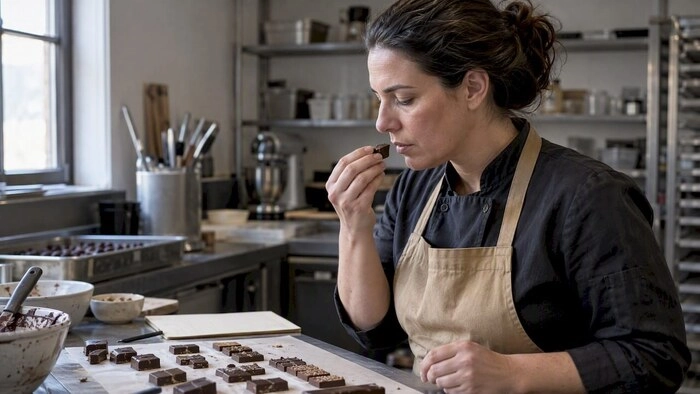
Explore eight 2026 chocolate flavor trends, from functional formulas to cocoa alternatives, and find R&D priorities and prototype ideas for product teams.
Chocolate flavour and innovation in 2026 centres on five themes: functional and wellness formulations, texture and format as a flavour lever, full-chain traceability, cocoa-free and cell-cultured alternatives, and global savoury crossovers. Industry analysis from IFT and Innova frames these as the year’s dominant directions, and we at BAM - Become A Master use them to shape which ingredients and formats we stock for prototyping.
Product teams rarely have time to chase every signal. These eight headlines, in order of commercial readiness, give a starting point for where to spend R&D hours first.
Each of these deserves its own prototyping line rather than a single catch-all SKU, since the sensory and sourcing requirements differ sharply.
Gut health, mood and sleep positioning now appear across new chocolate launches, with Innova’s 2026 overview citing rising functional inclusions and new consumption moments built around these benefits. Separately, observational research summarised by Harvard Health links moderate dark chocolate intake to cardiometabolic outcomes, though this should be framed as association, not a clinical claim.
Feasible inclusions and their constraints:
Format ideas: bite-sized functional squares for trial purchases, filled pralines for mood-targeted ranges, and protein-enriched bars for post-workout occasions.
Pro Tip: Start functional inclusions at the lowest effective dose and run sequential sensory panels, since chocolate’s own volatile aromatics are easily masked by strong actives.
Texture now functions as a flavour cue on its own, not just a mouthfeel detail. Mintel’s analysis points to texture-focused launches and smaller premium formats as two of the clearest growth levers heading into 2026.
Techniques and formats worth testing:
Portioning also protects margin: a smaller pack at a modest price point often outsells a large bar at full premium pricing, because trial risk feels lower to the buyer. Packaging that shows the inclusion layer through a window further supports this trial behaviour without added cost.
European buyers increasingly expect provenance and traceability as standard, not as a premium add-on. Innova’s European market report describes clean labels and provenance as central to premium positioning in the region, with organic and traceability claims carrying real weight at the shelf.
Practical implications for product teams:
Flavour pairing should start from the origin’s natural profile: citrus and red fruit for bright origins, warm spice and roasted nut for earthier ones.
Price volatility and environmental pressure on cocoa supply are accelerating investment into alternatives, with IFT reporting noting that cocoa-free analogues are already commercially emerging while cell-cultured cocoa still faces regulatory and scale hurdles.
Key distinctions for developers:
Developers testing alt-cocoa for the first time should treat it as a new ingredient category with its own processing rules, not a drop-in substitute.
Exotic and savoury pairings are moving from flavour-house concept work into limited retail launches. IFT’s Outlook 2026 flavour trends report names sweet corn, chipotle and pistachio-tahini as examples gaining traction, alongside early momentum for “neuroflavour” formulations.
Pairings and mechanics worth prototyping:
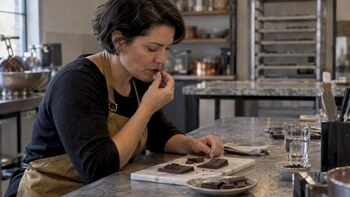
Small-batch panels of 15 to 20 tasters, judged on aroma, finish length and aftertaste bitterness, give a fast read before committing to a full production run.
Not every trend deserves equal investment. A simple framework keeps R&D focused on what is testable now versus what needs longer development.
This sequencing keeps spend proportional to how proven each trend already is.
We built our own range around the same logic product teams are applying industry-wide: ingredients and formats that let a kitchen test a trend before committing to full production. Our BAM Chocolate line gives bakers and chocolatiers a couverture base for coating trials, texture work and single-origin pairing experiments. Our 100% BAM Spreads work as a fast way to trial inclusion flavours such as pistachio or tahini-style pairings without reformulating a whole bar. For functional positioning, our BAM FIT products cover protein-enriched and sugar-reduced formats suited to wellness-led ranges.
Sourcing decisions increasingly shape flavour outcomes, not just supply chain ethics. Innova’s European report ties clean label and provenance expectations directly to how premium chocolate is positioned on shelf, and sustainable sourcing sits at the centre of that story.
Buyers increasingly expect to know not just where cocoa comes from, but how it was grown and traded. Fair-trade and organic certifications function as proof points that back up a traceability claim rather than standing alone as marketing. This matters for flavour too: shade-grown and agroforestry cocoa often develops different fermentation profiles than intensively farmed beans, producing subtler fruit and floral notes that single-origin bars are built to showcase.
For product teams, this means sourcing conversations with suppliers need to happen before flavour development starts, not after. A bean selected purely for cost will rarely deliver the sensory complexity that provenance-led marketing promises, and consumers who pay a premium for traceability notice the gap quickly. Pairing a sustainably sourced origin with a simple, honest ingredient list reinforces the same trust signal from two directions: how the cocoa was grown, and what else is in the bar.
Shorter supply chains, direct trade relationships and transparent farm-gate pricing are becoming part of the flavour story itself, since they let a brand explain why a particular bean tastes the way it does, not just where it came from.
Beyond the headline savoury crossovers, three pairing families are gaining steady traction: floral, spicy and herbal.
Floral pairings, such as rose, hibiscus and elderflower, work best against milk or white chocolate bases, where sweetness carries the floral note without competing against strong cocoa bitterness. Spicy pairings, including chilli, chipotle and pink peppercorn, perform well with dark chocolate, where the cocoa’s own bitterness balances heat rather than fighting it. Herbal pairings, such as rosemary, thyme and basil, suit single-origin dark chocolate with bright, fruity notes, since the herb’s green, aromatic character echoes rather than clashes with the bean’s acidity.
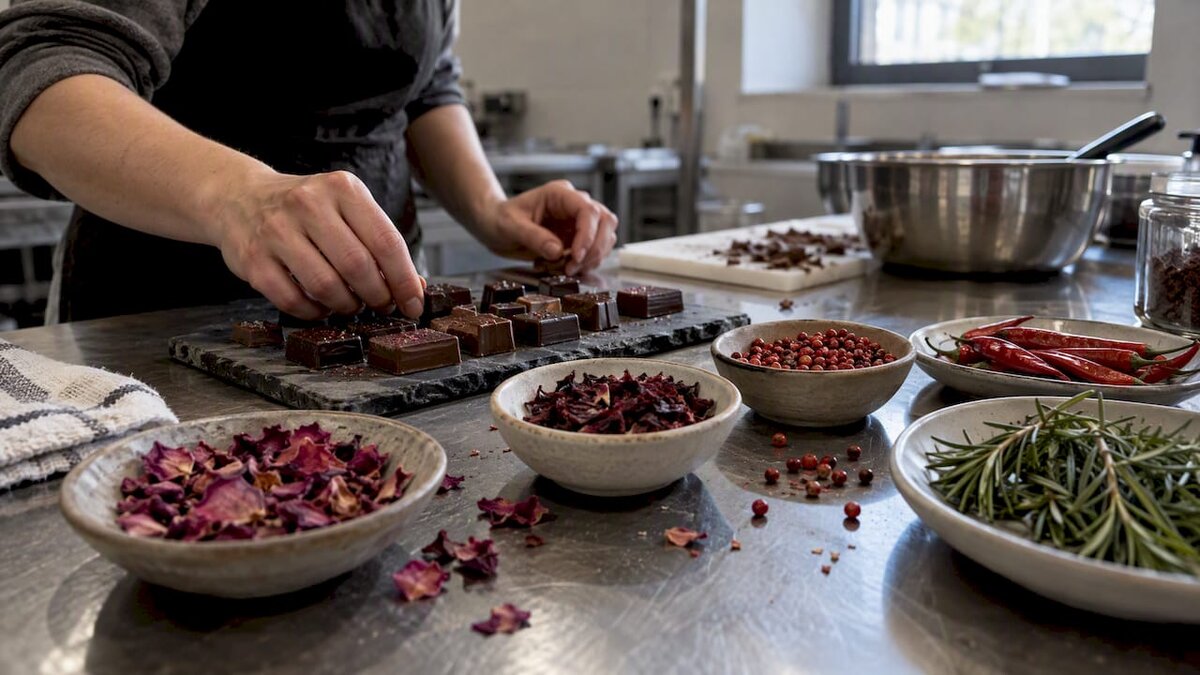
A practical rule for all three families: keep the inclusion or infusion subtle enough that chocolate remains the dominant flavour. Pairings that overwhelm the base read as a novelty item rather than a chocolate product, which limits repeat purchase. Testing at low concentration first, then scaling up only if the panel asks for more intensity, avoids the common mistake of over-flavouring a first batch.
Seasonal framing helps here too: floral pairings suit spring and gifting occasions, spice suits autumn and winter ranges, and herbal notes work year-round in premium single-origin lines.
Flavour development is becoming faster and more precise, with two tools standing out in trade commentary: precision fermentation and AI-assisted flavour design, both referenced by Mintel as near-term development tools rather than distant concepts.
Precision fermentation allows more control over the fermentation stage that gives cocoa its base flavour notes, potentially reducing batch-to-batch variation that has long been a challenge for chocolatiers working with single-origin beans. This matters particularly for smaller producers who cannot rely on blending large volumes to smooth out inconsistency.
AI-assisted flavour design is being used to model pairing combinations and predict which new flavour combinations are likely to test well before a single physical sample is made. This does not replace sensory panels, but it narrows the field of combinations worth testing, saving lab time on pairings unlikely to succeed.
Micro-encapsulation technology, already mentioned in the context of functional actives, also counts as a flavour technology in its own right: it allows volatile or heat-sensitive flavour compounds to survive tempering and shelf storage without degrading, which is particularly relevant for botanical and tea-infused ranges.
For smaller teams without access to AI modelling tools or fermentation labs, the practical takeaway is to lean on suppliers who have already invested in these processes, since the resulting ingredients, whether a fermentation-controlled couverture or an encapsulated active, carry the benefit through to the finished product without requiring in-house equipment.
Flavour preference is not uniform across age groups, and 2026 ranges increasingly reflect that. Innova’s global overview notes that a meaningful share of consumers, 44%, are drawn specifically to culturally rooted flavours, a figure that points to strong demand for heritage and regional profiles rather than purely novel combinations.
Younger consumers tend to respond well to bold, savoury and global crossover flavours, often seeking out limited releases for the discovery factor as much as the taste itself. Older consumers more often favour familiar, nostalgic flavour profiles delivered through a premium format, meaning the innovation sits in texture, provenance or packaging rather than in the flavour itself.
Functional positioning also skews by demographic: wellness-led formulations such as gut health or sleep-support chocolate tend to resonate more with buyers already engaged with supplements and functional foods, while indulgence-led premium bars perform better with gifting occasions across a broader age range.
For product teams, this means a single flavour strategy rarely works across an entire range. A portfolio that pairs one or two bold crossover flavours for younger, discovery-driven buyers alongside familiar profiles in premium formats for broader appeal covers more ground than a single flavour direction stretched across every pack size.
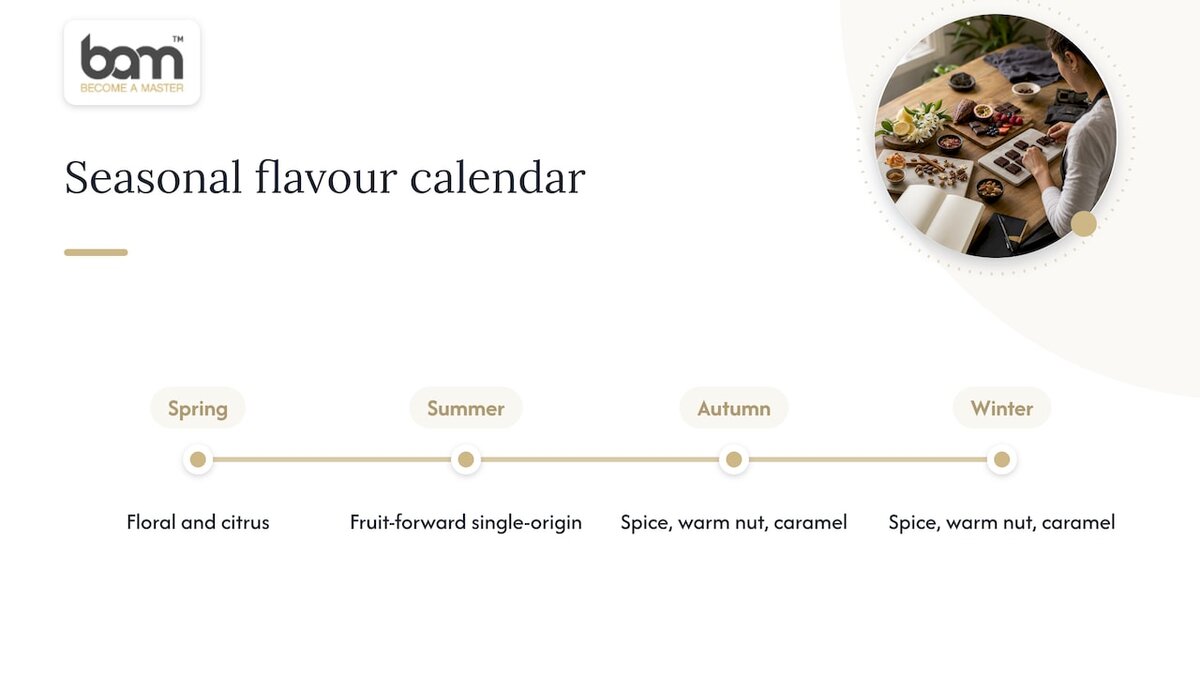
Seasonal and regional variation remains one of the more reliable levers for keeping a chocolate range feeling fresh without constant full reformulation.
Spring ranges lean toward floral and citrus notes, often timed around gifting occasions. Summer favours lighter, brighter profiles, including fruit-forward single-origin bars that suit warmer-weather consumption. Autumn and winter shift toward spice, warm nut and caramel notes, aligning with both seasonal eating patterns and gifting periods later in the year.
Regionally, European buyers show particular interest in provenance-led, clean-label positioning, as reflected in Innova’s Europe-specific report, while global flavour crossovers such as sweet corn or chipotle tend to launch first in markets more accustomed to bold, savoury snacking traditions before expanding elsewhere.
For a product calendar, this suggests building core, year-round SKUs around traceable single-origin positioning, then layering in two or three seasonal limited editions that reflect both the time of year and regional flavour appetite. This keeps the core range stable while giving retail buyers and consumers a reason to return across the year.
Traceability and clean labels are structural: they reflect a lasting shift in what premium buyers expect, not a passing cycle. Functional chocolate has real staying power too, though formulation discipline will separate credible products from gimmicks. Savoury crossovers and neuroflavour, by contrast, look more like a testing ground: a handful will become permanent fixtures, most will stay limited-edition novelties. Climate pressure on cocoa supply will keep pushing alt-cocoa investment regardless of consumer appetite.
— Andraz
Testing a trend before committing to full production shouldn’t require a factory-scale order. We put together small-format packs and curated sample boxes specifically so chocolatiers and product developers can trial pairings, textures and functional inclusions at low volume. Our BAMBox™ gives a ready starting point for themed sampling, and our Gifts range offers curated small formats suited to early consumer testing before a wider launch.
The clearest momentum is behind functional chocolate, where gut health, mood and sleep positioning are appearing in new launches, alongside savoury crossover flavours such as sweet corn and pistachio-tahini noted in IFT’s Outlook 2026 report. Texture-led premiumisation is running close behind as a second major direction.
There is no established industry or health standard known as the “5 chocolate bar rule”. Definitions circulating online vary and are not tied to a recognised nutritional or regulatory source, so we would treat any specific numeric claim with caution until it is confirmed by a credible body.
Single-origin beans from different regions produce distinctly different flavour palettes, with some origins leaning fruity and others earthier, which is why provenance now shapes pairing choices. Texture is increasingly treated as a flavour signal in its own right, and cocoa-free analogues are already commercially viable for coatings, according to IFT.
Observational research summarised by Harvard Health links moderate dark chocolate intake to lower diabetes risk, though this reflects association rather than a proven clinical effect. Framing should stay cautious, since individual health outcomes depend on far more than chocolate intake alone.




 Confectionery tips


 Slovenščina
 Hrvatski
 Deutsch
 Italiano
 Česky
 Polski
 Magyar
 Français
 Slovák
 Nederlands
 Español